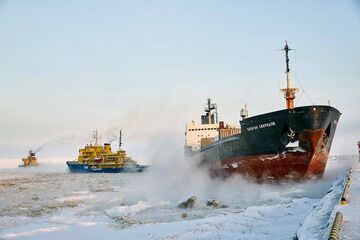
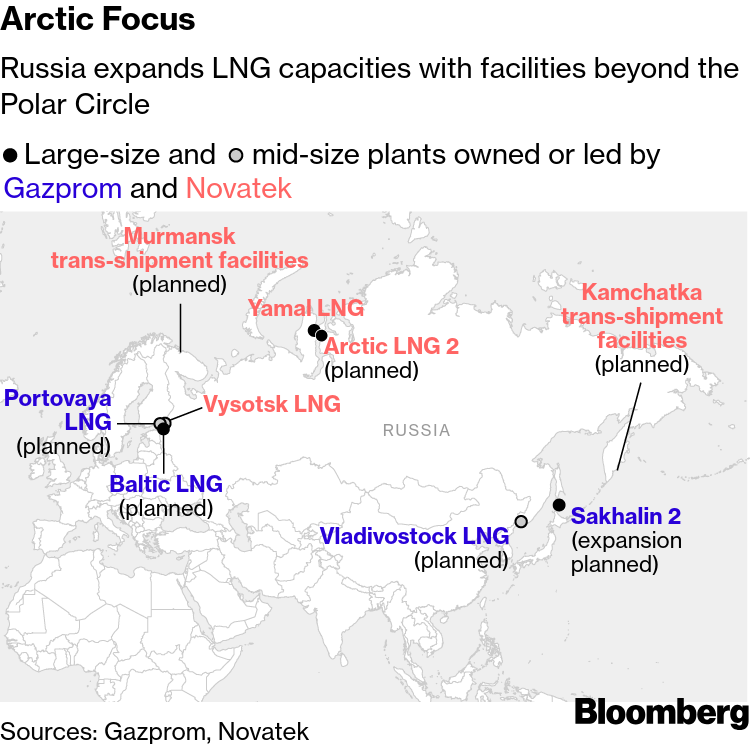
Almost 1,500 miles from Moscow, the tiny port of Sabetta nestles in a desolate Russian Arctic peninsula. A former outpost for Soviet geologists, it’s now the site of Russia’s most ambitious liquefied natural gas project, operated by a company that only entered the market just over a year ago.
Several times a week, a giant tanker leaves this remote place carrying the super-chilled fuel to buyers in Europe and Asia. It’s not the only LNG plant beyond the Arctic Circle, but it’s by far the largest.
Yamal LNG project’s port of Sabetta.
Source: Novatek
Novatek PJSC, the main shareholder of the Yamal LNG plant, says plans for further projects will transform Russia into one of the biggest exporters of the fuel within a decade. Already the world’s top exporter of pipeline gas and second-biggest shipper of crude oil, exports from Sabetta are giving President Vladimir Putin’s Russia another conduit into the world economy for the country’s unrivaled energy resources.
“Russia can be in the top four main LNG exporters,” Novatek’s Chief Financial Officer Mark Gyetvay said in an interview in London.
Showcasing The Potential
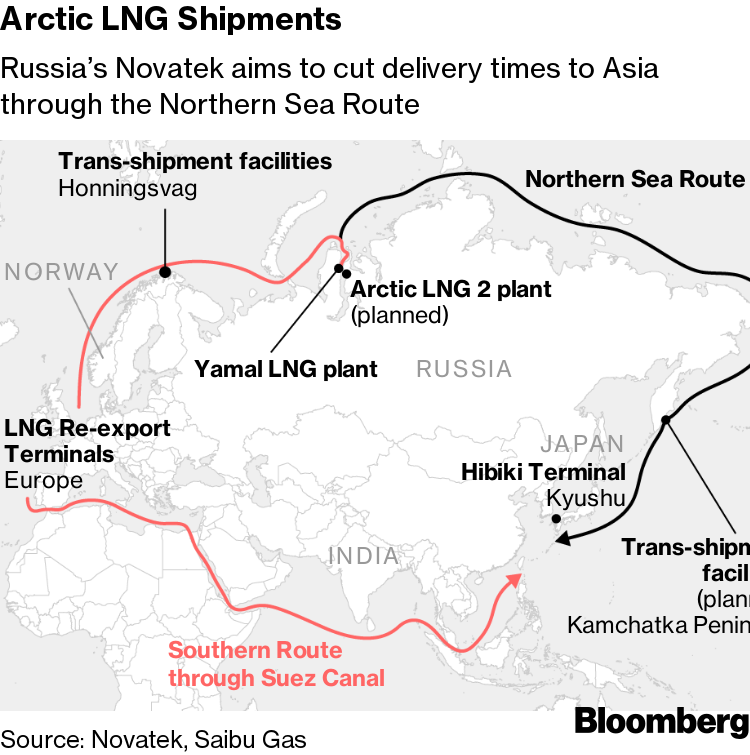
Novatek has demonstrated that it’s possible to produce and liquefy the fuel in such harsh conditions at competitive prices and ship it to markets thousands of miles away in Europe and Asia. That’s helped by receding Arctic ice which is allowing a specially built fleet of strengthened tankers to ship fuel along Russia’s northern coast.
This week, Putin will tout the potential for development of Russia’s hydrocarbons at the International Arctic Forum in St. Petersburg. Russia’s leader has been a long-standing supporter of developing oil and gas resources locked under the region’s permafrost. When opening the first production train of the Yamal LNG project in late 2017, Putin said the region gives Russia the opportunity to take up the fuel’s “niche it deserves.”
“We can boldly say that in this century and the next, Russia will expand thanks to the Arctic,” he said at that time.
Novatek, whose biggest shareholders include Russian billionaires Leonid Mikhelson and Gennady Timchenko, as well as French energy giant Total SA, became Russia’s top LNG producer after starting up its plant in the Yamal peninsula almost two years ago. The facility reached its full capacity at the end of 2018, ahead of schedule, doubling Russia’s share of the global LNG market to 8 percent.
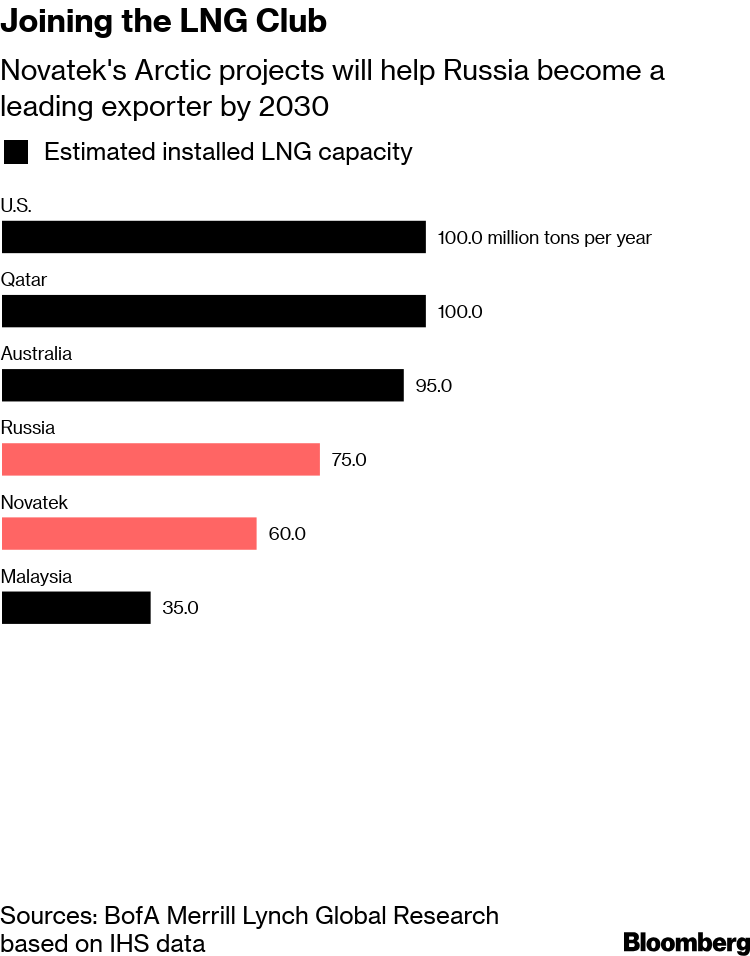
The gas producer has aggressive plans to command a 10th of the global market by 2030, Gyetvay said, and position Russia as one of the world’s largest exporters alongside the U.S., Qatar and Australia.
All three of Yamal LNG’s production units, with a combined actual capacity of 17.5 million tons a year, are now online. Novatek is attracting partners for a second plant, the so-called Arctic LNG 2 project, which is expected to come online in 2022.
The company is also considering commissioning a third facility and may increase its LNG production target for 2030 by about 20 percent, to as much as 70 million tons a year.
Novatek’s resource base at two Arctic peninsulas — Yamal and Gydan — allows the company to raise production volumes to as much as 140 million tons a year in future, according to its chief executive officer Mikhelson.
Russia, the world’s largest gas exporter, has been slow to join the global LNG boom as it has focused investment on pipeline supplies to Europe. Until recently, the country had just one liquefaction project in operation, the Gazprom PJSC-led Sakhalin 2 project near Japan with an annual capacity of about 10 million tons.
The country has now taken an interest in the market for tanker-borne fuel amid growing global LNG demand and more difficult relations with its customers in the European Union.
Vast Reserves
Russia’s Energy Ministry pegs total gas in place within the region at about 210 trillion cubic meters, or over 70 percent of the nation’s total. Novatek’s Arctic gas reserves are “conservatively” estimated at about 3.3 trillion cubic meters, Gyetvay said.
“We believe that Russia could be the fourth or even the third” biggest holder of LNG production capacity, said Karen Kostanian, Moscow-based oil and gas analyst for Bank of America Merrill Lynch.
The resources are located more than 5,000 kilometers (about 3,100 miles) away from key markets in Asia and are almost 4,000 kilometers from the European trading hub at the port of Rotterdam. That requires extensive shipping capability.
The freezing environment also means Novatek has to produce natural gas at temperatures as low as minus 56 degrees Celsius (about minus 69 Fahrenheit), according to regional government data. This requires special techniques for construction in permafrost areas, including installing pylons in ice, and for ships to navigate frozen routes.
Furthermore, not only does Novatek manage in the harsh environment but it sees the Arctic’s location as a competitive advantage, Gyetvay said, because the lower temperatures actually make production costs cheaper because less energy is needed to chill the gas.
The cost of producing Yamal feedstock gas is only around $0.1 per million British thermal unit, whereas U.S. producers typically buy their gas on a market such as the Henry Hub, where prices are currently about $2.60.
Eyes On The Prize
After starting up its $27 billion Yamal LNG project, Novatek is finalizing the partnership structure for the planned Arctic LNG 2 project.
Novatek’s potential has attracted investment from global players from Total to China National Petroleum Corp., a rare bright spot for Russia’s energy segment hit by U.S. and European sanctions. While Novatek is on the American sanctions list, and the U.S. Congress is considering restricting investment in Russia’s LNG facilities outside the country, it won’t impact the start-up of Arctic LNG 2 or the company’s longer-term expansion plans.
Total, a shareholder in Novatek’s first LNG project, last month signed a deal to buy a 10 percent stake in the second plant. The French major’s commitment could prompt a rush of other potential partners to take stakes in the project, Gyetvay said.
Whether other companies buy stakes in Arctic LNG 2 or not, Novatek will move forward with it regardless. The company is already doing pre-marketing for the future cargoes, discussing potential off-takers and volumes, Gyetvay said.
Last week, Novatek signed 15-year agreements with Vitol SA and Repsol SA to supply each with 1 million tons of LNG a year from the Arctic LNG 2 and other projects.
“We’re basically at that point in time when the train has started to move and it’s time to jump on or miss it,” Gyetvay said.
With assistance by Adrian Leung, Tsuyoshi Inajima, and Rob Verdonck
(Updates with production estimates by Novatek CEO in paragraph 12.)
TOKYO/SINGAPORE (Reuters) – Japan’s Tokyo Gas said on Friday it has signed a deal with Royal Dutch Shell for the long-term supply of liquefied natural gas (LNG), partly using a coal-linked pricing formula in an unusual move for an Asian LNG buyer.
This is believed to be the first time a Japanese buyer is using a coal-based pricing index in an LNG contract, industry observers said.
The companies signed a heads of agreement for Tokyo Gas to buy 500,000 tonnes a year of LNG for 10 years from April 2020.
Japan’s second-biggest LNG buyer is stepping up its efforts to diversify its supply sources and reduce costs.
“As far as Tokyo Gas and Shell know, this is the first time a pricing formula linked with a coal index has been used with LNG contracts,” a Tokyo Gas spokesman said.
A pricing formula based on coal indexation will be used for part of the supply, the spokesman said, while the rest will be priced off conventional gas- and oil-linked indexes. Tokyo Gas did not give the volumes to be done under each pricing method.
“With our long-term relationship and joint consideration, we were able to achieve an innovative agreement that would enhance further diversification of price indexation pursued by Tokyo Gas,” Tokyo Gas Managing Executive Officer Kentaro Kimoto said in a statement.
In Asia, most long-term LNG contracts are linked to oil prices, while supply from the United States is typically priced off the Henry Hub Index for natural gas.
Earlier this week, however, two U.S.-based firms announced alternative pricing options for contracts being signed for their new projects, ahead of an expected flood of supplies hitting global markets this year.
The deal follows a series of innovations in LNG contracts announced at the LNG2019 conference in Shanghai, said Nicholas Browne, a Wood Mackenzie analyst.
“Coal remains the largest competitor to gas in the power sector in Asia. If the index is competitive, this could be an important step for enabling LNG and utilities to better compete with coal,” Browne said.
As a gas and electricity provider trying to build its share in a competitive and liberalized power market, Tokyo Gas needs to compete with cheaper baseload coal-fired power, he said.
Tokyo Gas together with Japan’s Idemitsu Kosan and Kyushu Electric Power said in January they had given up their plan to build a 2 gigawatt (GW) coal-fired power station in Chiba, citing economic reasons.
“This deal may help them compete with cheaper coal based generation even though they don’t have much coal generation,” Browne said.
Shell will be supplying LNG to Tokyo Gas from its global LNG portfolio, rather than from specific LNG projects.
“Coal indexation in LNG contracts will be particularly relevant for Japanese buyers, not least because coal is an integral part of Japan’s power-generation mix,” said Abhishek Kumar, head of analytics at Interfax Energy in London.
“The move also demonstrates that some Japanese buyers are keen on spreading the price risk associated with LNG by diversifying price linkages to a variety of fuels,” he said.
(Reporting by Yuka Obayashi in TOKYO and Jessica Jaganathan in SINGAPORE; Editing by Richard Pullin and Tom Hogue)
SINGAPORE (Reuters) – China’s natural gas demand is set to grow by 14 percent in 2019 amid a huge government push to spur consumption of the fuel, a senior industry executive said, requiring the nation to import huge amounts of liquefied natural gas (LNG).
Yet even China’s booming consumption may not soak up a large glut of LNG that has emerged across Asia and dragged spot prices for the fuel down by 60 percent over the past half-year.
China’s gas demand will expand by 30 billion to 40 billion cubic meters (bcm) this year, said Li Yalan, chairwoman of Beijing Gas Group, main supplier to the Chinese capital, in an interview on Friday.
That would be an increase of as much as 14 percent from the 280 bcm of gas China consumed in 2018, according to data from the state economic planner, the National Development and Reform Commission (NDRC). It would also be slower than China’s 2018 demand surge of 18 percent.
The rising gas demand is a result of China’s ongoing policy to move households and industry from coal to gas, as well as economic stimulus that includes a value-added tax cut from April 1 and which is aimed at supporting industry growth.
Li said Beijing, one of the world’s biggest gas-burning cities, consumed a record 18.5 bcm of gas last year, up 14 percent from 2017.
“The broad direction is not going to change, which is to restructure the energy mix by increasing the share of natural gas,” Li told Reuters.
“What China needs to do is to connect the gas supplies with the demand nicely to ensure a smooth switch.”
Better state planning to ensure grid connections and to encourage energy companies to boost imports in advance helped China’s gas market, the world’s third-largest, to expand by a record 43 bcm last year, Li said.
The expansion came after a supply crunch over an unusually cold winter of 2017/18 as suppliers struggled to meet a demand surge that followed a policy to move millions of households to gas from coal.
“This year we’ll likely see the market growing between 30 and 40 bcm, which is a normal range,” said Li.
Although China’s domestic gas production is also rising fast, its 2018 growth of 7.5 percent cannot fully keep up with the nation’s expanding consumption.
CAN CHINA SOAK UP ASIA’S GLUT?
With new gas piped from Russia due only toward end-2019, China is expected to ramp up imports of LNG, said Li.
China, the world’s second-largest LNG buyer behind Japan, boosted imports 41 percent in 2018 to 54 million tonnes. That followed growth of almost 50 percent in 2017.
But the booming consumption in China is the lone bright spot. Asia is in the midst of a large supply glut that has dragged down spot prices for LNG by 60 percent since mid-2018, to below $5 per million British thermal units (mmBtu).
(Graphic: Asia LNG supply vs GDP growth – tmsnrt.rs/2WT6FxI)
This could mean gas producers are in for a stretch of low Asian prices as demand growth, especially outside China, falls behind a supply surge amid an economic slowdown, resilient coal consumption in many emerging markets, and also the rise of renewables.
While demand growth outpaced supply between 2016 and 2019, new production – mostly from the United States, Australia and Russia – is expected to exceed consumption increases this year by more than 2 percent, according to industry data.
“China could not itself absorb the avalanche of … projects,” said Fereidun Fesharaki, chairman of energy consultancy FGE, in a note.
“The surplus can continue till end 2020 or early 2021,” he said.
Despite the glut, analysts say Asia’s spot LNG prices may have hit a floor around the current levels of $4.5 per mmBtu.
“The marginal cash cost of LNG supply is circa $4.50 per mmBtu, which implies we are close to the price floor,” Bernstein Energy analysts said in a note this month.
(Graphic: Asia LNG price vs supply – tmsnrt.rs/2WUxqC1)
(Reporting by Chen Aizhu and Henning Gloystein; Editing by Christian Schmollinger and Tom Hogue)
Our standards: The Thomson Reuters Trust Principles.
Dan Yurman looks at plans for Small and Micro Nuclear Reactors. A UK report on Micros that generate 30MW says it’s an opportunity for the country to own the IP and export units that are simple in design, factory constructed and capable of being sited in remote locations. Given the rough ride nuclear can get, the report warns that progress will depend on political, regulatory and financial support. Meanwhile, in the US,Westinghouse will have a 25MWe unit ready to test by 2022. And while the world waits for such Micros, China will begin construction at the end of this year of a 125MW Small Modular Reactor, expected to be operational in 2025.
Westinghouse launches new SMR effort
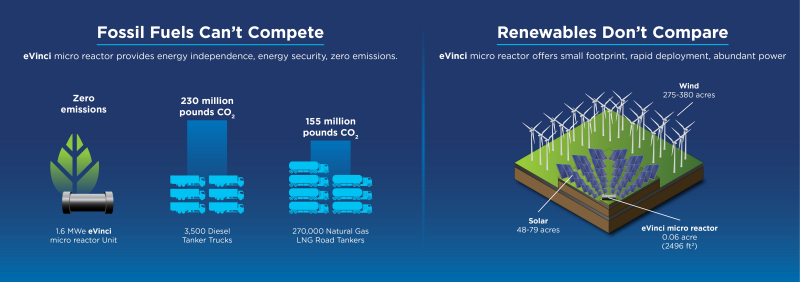
After several earlier false starts, including a complete withdrawal in 2014 from efforts to enter the SMR market, Westinghousebuoyed with a $12.9 million grant from theU.S.Department of Energy, is making another go of it. The firm said it will spend $28.9 million to demonstrate the readiness of the technology of its 25-MWe eVinci micro-reactor by 2022.
The government money, which is covering about half of the costs, will cover costs used toward design, analysis, licensing to manufacture, siting, and testing work.
The monolith will serve as the second fission product barrier (the fuel pellet is the first barrier) as well as the thermal medium between the fuel channels and heat pipes. The heat pipes will extract heat from the core using a technology based on thermal conductivity and fluid phase transition.
Key technical attributes
On its website Westinghouse said the reactor’s small size and innovative design set it apart. (Technical Profile – PDF file) Here’s a short list of key technical details.
Transportable as a reliable energy generator
Fully factory built, fueled and assembled
Output of 25 MWe electrical
Up to 600ºC process heat for petro chemical and other industrial uses
5- to 10-year life with walkaway inherent safety
Target less than 30 days for onsite installation
Autonomous load management capability
Proliferation resistance through encapsulation of fuel
Minimal moving parts
Challenges ahead for a new design
Westinghouse told Power Magazine that it faces several key challenges. First among them is getting enough HALEU fuel. The Department of Energy is supporting multiple efforts to address that issue including a contract to produce it by Centrus Corp by 2020 and deployment of a HALEU-based TRISO-X fuel fabrication pilot line at the Oak Ridge National Laboratory.
Other issues which are faced by all SMR developers include the question of how many deals are needed to be inked in their order books to get investors to provide the fundsfor factory production facilities.
Because the design is unique, Power Magazine noted that Westinghouse will have to go through the long and expensive safety evaluation process at the NRC. The firm told Power Magazine it faces “first of a kind” challenges in licensing, instrumentation, remote reactor monitoring, and logistics.
“These challenges require careful risk management and planning, but they are not considered showstoppers and their management is part of the Westinghouse eVinci reactor development program.”
Small modular reactors have big potential market in UK, says government-funded report
(NucNet): Micro nuclear reactors (MNRs) are a feasible option for the UK and have a potential market in the hundreds by 2030, a new government-funded report has concluded.
The report, produced by Nuvia, WSP and Atomic Acquisitions, concludes that there is great potential for development of MNRs between 2030 and 2035.
It says MNRs, typically under 30 MW, could bring significant economic benefits to the UK but must be “decisively supported” because they will only proceed with clear support and facilitation of political, regulatory and financial factors.
The study, Market and Technical Assessment of Micro Nuclear Reactors, says;
“Due to their size and unique characteristics, there are several potential market opportunities for MNRs. A potential global accessible market of up to 2,850 megawatts has been estimated by around 2030,” the report says.
“A potential MNR industry could enable the UK to grow indigenous civil nuclear reactor manufacturers gaining intellectual capital at low entry cost. At present this core part of the civil nuclear supply chain is not provided in the UK.”
In its conclusions the report says key advantages of micro reactors include simplicity of design, including safety systems; potential ease of construction through factory construction; lower overnight cost of each unit resulting in ease of financing; and the possibility of placing reactors in remote locations.
December construction start for Chinese 125 MWe SMR
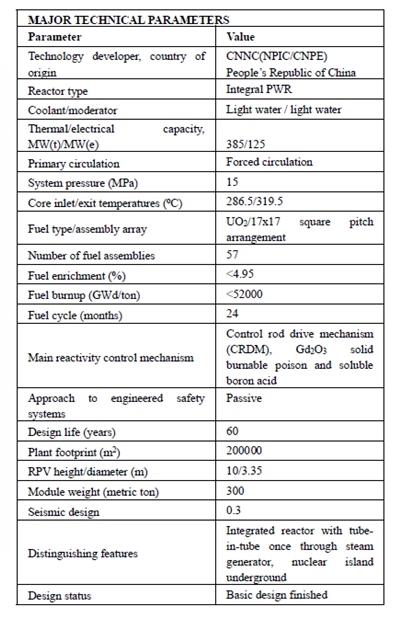
(WNN) China’s Ministry of Environment is proceeding to build an ACP100 small modular reactor (SMR) at Changjiang, Hainan, with construction to begin by the end of this year.
According to Chinese publication Nuclear World, construction is expected to take 65 months with the 125 MWe unit expected to start up by May 2025.
According to data about the ACP100 in the IAEA “SMR Book,”the ACP100 is a multipurpose power reactor designed for electricity production, heating, steam production or seawater desalination and is suitable for remote areas that have limited energy options or industrial infrastructure.”
The design, which has 57 fuel assemblies and integral steam generators, (see table right) incorporates passive safety features and will be installed underground.
A two-unit ACP100 plant will be located on the northwest side of the existing Changjiang nuclear power plant, according to the 22 March announcement. The site is already home to two operating CNP600 PWRs, with two Hualong One units also planned for construction at that site.
***
Dan Yurman is the author of Neutron Bytes and writes on nuclear matters.
According to the International Renewable Energy Agency (IRENA), renewable energy sources (RES) could account for 86% of power generation in 2050. IRENA’s reference scenario foresees electricity to become the central energy carrier, reaching a 50% share of final energy consumption by 2050 (from the current 20%). Renewable power development should benefit from the fall in the Levelized Costs Of Electricity (LCOE), which should halve between 2010 (US$80/MWh) and 2050 (US$40/MWh) for wind power and divide 9-fold for solar, from US$347/MWh in 2010 to US$38/MWh in 2050. Solar PV deployments could accelerate from the current 109 GW/year to 360 GW/year in 2050, while wind capacity additions could surge from around 54 GW/year to 240 GW/year.
Conversely, fossil fuel consumption would decline: oil demand would be reduced to 22 mb/d (from current 95 mb/d), gas demand would reach 2,250 bcm/year (from around 3,750 bcm/year in 2018) and coal demand would collapse from around 5,360 Mtce/year in 2018 to 713 Mtce/year in 2050. The investment required to decarbonise the global energy system is estimated at US$15,000bn by 2050 (-40% than previous estimates due to decreasing renewable power generation costs).
The higher renewable power generation could cut CO2 emissions by 27% in 2030 (compared to the current level), by 48% in 2040 and by 71% in 2050, leading to a fall in CO2 emissions per capita, from 4.3 tCO2/cap in 2010 to 1.1 tCO2/cap in 2050.
China expects to increase its coal production by 100 Mt in 2019 from the 3.5 Gt produced in 2018. Despite China’s commitment to cut excess produciton capacity, production will be boosted by the 194 Mt/year of new coal mining capacity approved in 2018 and by the 29.5 Mt/year new coal mining capacity to be added in 2019. Consequently, coal imports could decrease by 10 Mt to 12 Mt in 2019.
China is by far the world’s largest coal producer, with a production that increased by 3% in 2018 (+100 Mt). Coal production increased rapidly over 2000-2011 (almost 9%/year) before peaking in 2013 at 3.8 Gt and reducing until 2016. The trend shifted in 2017, when production grew again (+100 Mt or +3%). The northern and north-western regions are the main production areas.
According to the China Electricity Council (CEC), China’s installed capacity should reach around 2,000 GW at the end of 2019, representing a total increase of more than 100 GW compared to 2018 (1,900 GW). Most of the capacity increase – around 62 GW – will come from non-fossil fuel capacities. Coal consumption for power generation is expected to increase by 80 Mt in 2019.
China is the world leader in annual newly installed capacities for wind and solar. The wind power capacity increased by more than 20 GW in 2018 (+13%) and reached 184 GW. Overall, Chinese wind power capacity has increased nearly sixfold since 2010. Solar power capacity have soared over the past years, from less than 900 MW in 2010 to more than 130 GW in 2017 (+53 GW over 2016) and to nearly 175 GW in 2018 (+44 GW in 2018).
The Ashalim solar and thermal electric power plant in Israel’s Negev Desert is up and running. The state-of-the-art facility is equipped with more than 50,000 computer-controlled heliostats or mirrors, which can track the sun in two dimensions and reflect the sunlight onto a boiler placed on top of a tower measuring 240 m-high (787.4 ft). That’s higher than some of the tallest sky scrapers in the world and by far the tallest solar tower ever built.
How does it work? All those tens of thousands of mirrors are hooked up to a computer operated tracking system so that they all move precisely with the orbit of the earth around the sun throughout the day and direct the heat from the sunlight to a spot on the boiler on top of the tower to within 0.0015499969 of an inch. The super hot water in the boiler produces superheated steam, which is then conveyed through pipes down below with enough pressure to spin a steam turbine-generator at astronomical speeds needed to produce electricity. The solar run generator can put out 300 megawatts of clean electricity every day, or enough to power about 150,000 homes.
Another feature of the Ashalim project is the use of solar thermal technology that can store energy for use at night in order to provide consistent and reliable output of electricity. This is one of the largest renewable energy projects in the world. The facility covers an area of over 3 sq. km (2 sq. miles).
Israel’s climate is ideal for solar power, particularly in the Negev which enjoys more than 300 sunny days a year. Israel has been home to many solar technology breakthroughs, but the government has been slow in getting away from using fossil fuels for power. But that is definitely starting to change with a goal getting 10 percent of its energy needs from renewable sources by 2020 with the new solar project. Once the project is proven fully successful, Israel plans to move ahead rapidly towards renewable energy sources.
Together with the recent discovery of huge deposits of natural gas along Israel’s Mediterranean Coast, the Ashalim plant will contribute to Israel’s security by reducing dependence on fossil fuel imports. It will also keep us safe by keeping 110,000 tons of CO2 emissions per year out of the air we breath.
Lebanon announced on Friday five offshore blocks to be included in its coming bidding round for energy exploration and production licenses, including four along disputed maritime borders.
Offshore energy development has been a central ambition for successive governments in cash-strapped Lebanon, but political paralysis has caused years of delays.
Blocks 8 and 10 both include waters also claimed by Israel, while blocks 1 and 2 include waters claimed by Syria. One of the two blocks for which licenses were awarded last year, block 9, is also on the disputed maritime border with Israel.
Energy Minister Nada Boustani announced details in a televised news conference of the upcoming licensing round, which she said on Thursday had been approved by the cabinet and would have a bid deadline in early 2020.
A consortium of France’s Total, Italy’s Eni and Russia’s Novatek won the first licensing round last year for blocks 4 and 9 and plans to drill its first exploration wells by the end of this year. It has said it will avoid disputed waters.
“We expect greater participation in the second round of licensing,” Boustani said, adding that representatives from Russia’s Lukoil, Spain’s Repsol and Britain’s BP had visited Lebanon in the last few weeks.
“For sure Total and Eni are still interested,” she added.
Lebanon is on the Levant Basin in the eastern Mediterranean where a number of big sub-sea gas fields have been discovered since 2009 in waters off Cyprus, Israel and Egypt.
Beirut tried to launch its first offshore exploration in 2013, but domestic political problems delayed it until 2017.
For this round, it has merged the pre-qualification process for license bidders into the bidding process.
Pro-transparency group, the Lebanese Oil and Gas Initiative, urged the government to reconsider the decision, saying it might make the process more opaque.
MOSCOW (UrduPoint News / Sputnik – 05th April, 2019) The Nord Stream 2 gas pipeline project will be implemented even with the introduction of amendments to the EU Gas Directive, Russian Energy Minister Alexander Novak told reporters Friday.On Thursday, the European Parliament approved amendments to the EU Gas Directive, which relate to the rules of operation of offshore sections of gas pipelines in the European Union. Now the amendments should be finally approved by the Council of the European Union.”Based on the draft [amendments to the Gas Directive] that were considered and adopted by the European Parliament yesterday, we can say the project will be implemented. And, of course, it will be implemented under this legislation, within the framework of what may be adopted.That is, these Gas Directive requirements will be implemented,” Novak said when asked if changes to the EU Gas Directive would affect the implementation of the Nord Stream 2 project.The Nord Stream 2 project is a joint venture of Gazprom and five European companies: France’s ENGIE, Austria’s OMV, British-Dutch Royal Dutch Shell, and Germany’s Uniper and Wintershall. The 745-mile-long pipeline is set to run from Russia to Germany to deliver Russian gas to European consumers.The pipeline project has been welcomed by some countries in Europe and opposed by others who raise concerns over the alleged danger of Europe’s dependence on Russia and subsequent diminished transit role of Ukraine. Moscow has repeatedly reiterated that the pipeline is a purely commercial project.https://www.urdupoint.com/en/amp/world/nord-stream-2-to-be-implemented-even-with-ame-586932.html?__twitter_impression=true