International Energy Consultant Roudi Baroudi Releases New Book on Hormuz
Posted By
admin
On
In
Adnoc,Aramco,athensenergydialogues,Blue Economy,Business,chemical,China,Clean Energy,Climate,climateaction,climatechange,coronavirus,cyprus,decarbonization,Economy,Energy,energyindustry,Europe,Finance,greece,Hormuz,lebanon,LNG,Maritime Disputes,nuclear,Oil & Gas,Politics,Qatar,qatarenergy,renewableenergy,Roudi Baroudi,russia,Saudi Arabia,Strait of Hormuz,sustainability,Syria,Uncategorized,رودي بارودي |
Comments Disabled
A new book[1] titled “The Wars of the Straits – Hormuz[2] Case: The Impact on World Energy Markets” by Dr. Roudi Baroudi[3], an international energy consultant and member of the Transatlantic Leadership Network (TLN), was released Tuesday in Washington, D.C.
The book[1] offers a comprehensive examination of the crises of 2026 and their repercussions, tracing the historical roots of conflicts over strategic waterways while exploring options to reduce the risks of similar disruptions in the future.
From the “Tanker War” to the Genoa-Venice Rivalry
Baroudi does not confine his analysis to modern confrontations in the Gulf or the “Tanker War” of the 1980s. Instead, he traces the concept of “wars of the straits” back some seven centuries, examining the medieval rivalry between Genoa and Venice over access routes to the Bosporus and the Black Sea.
Through this approach, the book[1] places the events of 2026 within a broader historical context of competition over maritime corridors, highlighting their role in great-power rivalry and their use as instruments of political and economic pressure during periods of crisis.
According to the announcement issued by the Transatlantic Leadership Network, the book[1] combines geopolitical narrative with legal and technical analysis. It examines the international legal framework governing the Strait of Hormuz[2], the maritime and commercial confrontations that unfolded during the 2026 war, as well as the economic and environmental consequences of disruptions to navigation and shipping.
The book[1] also examines the practical viability of alternative pipeline routes and their ability to reduce dependence on the strait during periods of crisis, particularly so-called “bypass pipelines,” given Hormuz[2]’s central role in global energy flows and international trade.
The significance of these alternatives, according to the book[1]’s analysis, goes beyond calculating their theoretical capacity to transport oil and gas away from the strait. It also involves assessing their practical feasibility and the technical and economic constraints that may limit their ability to compensate for shipping through Hormuz[2] in the event of widespread disruption.
The book[1] includes appendices addressing the U.S.-Iranian Memorandum of Understanding signed on June 17, 2026, the world’s most important straits and waterways, the strategic relationship between the Strait of Hormuz[2] and Bab el-Mandeb, as well as several maritime boundary delimitation agreements in the region.
By linking Hormuz[2] to Bab el-Mandeb and other vital maritime corridors, the book[1] expands the discussion beyond the crisis of a single strait to the broader question of global trade and energy security, and the vulnerability of international markets and economies when narrow maritime chokepoints become arenas of confrontation or instruments of leverage in geopolitical disputes.
“The Wars of the Straits – Hormuz[2] Case” argues for the development of a sustainable international framework grounded in international law, scientific evidence, and facts, with the aim of safeguarding freedom of navigation through the strait and reducing the risks associated with the use of maritime corridors in international conflicts.
In this context, the book[1] connects energy security, freedom of navigation, and regional stability, based on the premise that any major disruption to shipping through strategic straits does not remain confined to the countries bordering them. Its effects can extend to energy markets, supply chains, global trade, and the marine environment.
The Transatlantic Leadership Network (TLN), with which Baroudi is affiliated, announced the book[1]’s release, highlighting its geopolitical, legal, and technical scope, while Casemate is handling its distribution.
“حروب المضائق – حالة هرمز” كتاب جديد لرودي بارودي يقرأ أزمات 2026
Posted By
admin
On
In
Adnoc,Aramco,athensenergydialogues,Blue Economy,Business,chemical,China,Clean Energy,Climate,climateaction,climatechange,coronavirus,cyprus,decarbonization,Economy,Energy,energyindustry,Europe,Finance,greece,Hormuz,lebanon,LNG,Maritime Disputes,nuclear,Oil & Gas,Politics,Qatar,qatarenergy,renewableenergy,Roudi Baroudi,russia,Saudi Arabia,Strait of Hormuz,sustainability,Syria,Uncategorized,رودي بارودي |
Comments Disabled
صدر الثلاثاء في العاصمة الأميركية واشنطن كتاب «حروب المضائق – حالة هرمز: التأثير في أسواق الطاقة العالمية» (The Wars of the Straits – Hormuz Case: The Impact on World Energy Markets) للدكتور رودي بارودي، المستشار الدولي في شؤون الطاقة والعضو في شبكة القيادة عبر الأطلسي (TLN)، مقدّماً قراءة شاملة لأزمات عام 2026 وتداعياتها، والجذور التاريخية للصراع على الممرات البحرية الاستراتيجية، فضلاً عن الخيارات المتاحة للحد من مخاطر اضطرابات مماثلة مستقبلاً.
من «حرب الناقلات» إلى صراع جنوى والبندقية
لا يحصر بارودي بحثه في المواجهات الحديثة في منطقة الخليج أو في «حرب الناقلات» خلال ثمانينيات القرن الماضي، بل يعود بمفهوم «حروب المضائق» نحو سبعة قرون، مستعرضاً الصراع بين جنوى والبندقية في العصور الوسطى على طرق الوصول إلى مضيق البوسفور والبحر الأسود.
ومن خلال هذه المقاربة، يضع الكتاب أحداث عام 2026 ضمن سياق تاريخي أوسع للصراع على الممرات البحرية، ودورها في تنافس القوى الدولية، واستخدامها أداةً للضغط السياسي والاقتصادي خلال الأزمات.
ويجمع الكتاب، وفق الإعلان الصادر عن شبكة القيادة عبر الأطلسي، بين السرد الجيوسياسي والتحليل القانوني والتقني، متناولاً قواعد القانون الدولي الناظمة لمضيق هرمز، والمواجهات البحرية والتجارية خلال حرب عام 2026، فضلاً عن التداعيات الاقتصادية والبيئية الناجمة عن اضطراب حركة الملاحة والشحن.
كما يتوقف عند الجوانب العملية للمسارات البديلة لخطوط الأنابيب ومدى قدرتها على تخفيف الاعتماد على المضيق في أوقات الأزمات، ولا سيما ما يُعرف بـ«خطوط الأنابيب الالتفافية» (Bypass Pipelines)، في ظل المكانة المحورية التي يحتلها هرمز في حركة الطاقة والتجارة العالمية.
ولا تقتصر أهمية هذه البدائل، بحسب المقاربة التي يقدمها الكتاب، على حساب القدرة النظرية لنقل النفط والغاز بعيداً عن المضيق، بل تشمل أيضاً دراسة الجدوى العملية لهذه المسارات والقيود التقنية والاقتصادية التي يمكن أن تحد من قدرتها على تعويض حركة الشحن عبر هرمز عند حدوث اضطرابات واسعة.
هرمز وباب المندب
ويتضمن الكتاب ملاحق تتناول مذكرة التفاهم الأميركية – الإيرانية الموقعة في 17 حزيران 2026، وأهم المضائق والقنوات المائية في العالم، والعلاقة الاستراتيجية بين مضيق هرمز وباب المندب، فضلاً عن عدد من اتفاقيات ترسيم الحدود البحرية في المنطقة.
ومن خلال الربط بين هرمز وباب المندب وغيره من الممرات البحرية الحيوية، يوسّع الكتاب النقاش من أزمة مضيق بعينه إلى مسألة أكثر شمولاً تتعلق بأمن طرق التجارة والطاقة العالمية، ومدى تأثر الأسواق والاقتصادات الدولية عندما تتحول نقاط العبور البحرية الضيقة إلى ساحات مواجهة أو أدوات ضغط في النزاعات الجيوسياسية.
ويطرح «حروب المضائق – حالة هرمز» الحاجة إلى تطوير إطار دولي مستدام يستند إلى القانون الدولي والمعطيات العلمية والوقائع، بما يسهم في ضمان حرية المرور عبر المضيق والحد من مخاطر استخدام الممرات البحرية في الصراعات الدولية.
ويربط الكتاب، في هذا السياق، بين أمن الطاقة وحرية الملاحة والاستقرار الإقليمي، انطلاقاً من أن أي اضطراب كبير في حركة السفن عبر المضائق الاستراتيجية لا يبقى محصوراً بالدول المطلة عليها، بل يمكن أن تمتد آثاره إلى أسواق الطاقة وسلاسل الإمداد والتجارة والبيئة البحرية.
وأعلنت شبكة القيادة عبر الأطلسي (TLN)، التي يعمل بارودي لديها، صدور الكتاب، مشيرة إلى طابعه الجيوسياسي والقانوني والتقني، فيما تتولى Casemate توزيعه.
US blockade succeeds where sanctions failed as Iran oil exports stall
Posted By
admin
On
In
Adnoc,Aramco,athensenergydialogues,Blue Economy,Business,chemical,China,Clean Energy,Climate,climateaction,climatechange,coronavirus,cyprus,decarbonization,Economy,Energy,energyindustry,Europe,Finance,greece,Hormuz,lebanon,LNG,Maritime Disputes,nuclear,Oil & Gas,Politics,Qatar,qatarenergy,renewableenergy,Roudi Baroudi,russia,Saudi Arabia,Strait of Hormuz,sustainability,Syria,Uncategorized,رودي بارودي |
Comments Disabled
Summary
Iran crude exports halted for record seven weeks
Blockade succeeds where years of sanctions failed
China cut off from fresh Iranian crude
LONDON, Sept 1 (Reuters) – For the first time on record, Iran has gone about seven weeks without shipping meaningful crude exports through the Strait of Hormuz, as a U.S. naval blockade succeeds where years of sanctions failed by cutting off one of Tehran’s main sources of foreign-currency earnings.
Unlike previous sanctions campaigns, when Iranian crude continued reaching buyers despite restrictions, the current blockade has stopped fresh crude cargoes reaching China, Tehran’s only major remaining oil customer, increasing pressure on government finances and foreign-currency reserves.
Since the U.S. reinstated its blockade on Iran on July 14 as part of their six-month conflict, no Iranian crude cargoes have successfully transited the Strait of Hormuz to China, according to Kpler, Vortexa and TankerTrackers.com.
As a result, Iran can only sell crude to China from floating storage in Asia, which it cannot replenish as crude accumulates aboard tankers inside the strait.
“Even at the height of maximum-pressure sanctions in 2019-20, some Iranian crude cleared Hormuz every single month; at no point did outbound flows fall to near-zero for a sustained stretch as they have since mid-July,” Vortexa analyst Claire Jungman said.
Iran loaded about 220,000 to 255,000 barrels per day of crude oil and condensate in August, according to Vortexa and Kpler estimates, down from roughly 740,000 bpd in July and about 2 million bpd in March.
U.S. blockade leaves Iranian crude trapped inside Hormuz
Iran’s crude oil and condensate exports have fluctuated during the conflict as Washington alternated between sanctions relief and enforcement, suspending the blockade in June before reinstating it on July 14.
The collapse in exports is draining one of Iran’s main sources of foreign-currency income and could force Tehran to finance spending by printing money, risking even higher inflation, Kpler analyst Homayoun Falakshahi said.
The International Monetary Fund estimates Iran’s inflation rate at nearly 70% this year, the world’s third-highest after Venezuela and Sudan.
Last week, Washington sought to increase the pressure by threatening[6] countries that continue trading with Tehran, while stopping short of immediately imposing penalties.
The U.S. blockade does not extend along Iran’s entire coastline. It sits farther south, between the Gulf of Oman and the Arabian Sea, where U.S. Navy vessels vet ships departing from and approaching Iranian ports.
Beyond the blockade zone, dozens of Iran-linked shadow-fleet tankers remain active, with 51 vessels operating in the Gulf of Oman and another 81 making deliveries in Asia or waiting off Malaysia, according to David Tannenbaum of Blackstone Compliance Services.
Reuters could not independently verify those figures.
IRANIAN CRUDE STILL FOR SALE, BUT FOR HOW LONG?
Iranian crude remains openly available, with cargoes for September and October delivery to China being offered, traders said[7].
They said available volumes are lower than for July and August because floating storage outside the Gulf is shrinking as no fresh supply arrives.
Iranian crude in floating storage west of the blockade line rose to 41.7 million barrels by August 26 from 35.5 million at the end of July, while total Iranian crude afloat fell to 107 million barrels from 135 million, according to Vortexa data.
“China can grab whatever’s floating around in their neck of the woods, but that’s about it for now, really,” TankerTrackers co-founder Samir Madani said.
Once sold, empty tankers cannot return to Iranian ports because of the blockade, leaving vessels idle offshore.
Vortexa’s Jungman said 27 sanctioned tankers linked to Iran’s oil trade are currently waiting off Sri Lanka in ballast, unable to return to Iran.
Reporting by Ahmad Ghaddar, Enes Tunagur and Robert Harvey. Additional reporting by Siyi Liu and Chen Aizhu in Singapore. Editing by Mark Potter
US urges G20 to cut trade imbalances, focus on China
Posted By
admin
On
In
Adnoc,Aramco,athensenergydialogues,Blue Economy,Business,chemical,China,Clean Energy,Climate,climateaction,climatechange,coronavirus,cyprus,decarbonization,Economy,Energy,energyindustry,Europe,Finance,greece,Hormuz,lebanon,LNG,Maritime Disputes,nuclear,Oil & Gas,Politics,Qatar,qatarenergy,renewableenergy,Roudi Baroudi,russia,Saudi Arabia,Strait of Hormuz,sustainability,Syria,Uncategorized,رودي بارودي |
Comments Disabled
By AP and Reuters
Published On 1 Sep 20261 Sep 2026
United States Treasury Secretary Scott Bessent is urging some of his G20 counterparts to take a page from the Trump administration’s playbook of using tariffs and other measures to crack down on trade imbalances.
The administration of US President Donald Trump urged other G20 countries on Tuesday to do more to protect their domestic industries and job markets from Chinese imports, arguing that such distortions were “sucking” much-needed growth out of the global economy.
The two-day meeting of finance chiefs in Asheville, North Carolina, came amid a global bond market selloff on worries over growing debt levels and inflation pressures.
Bessent said he had already warned other trading partners last year that tougher US tariffs would lead to an influx of Chinese goods diverted to their markets.
“And unfortunately, I was right. They have – and the rest of the world probably needs to take a hard look at what they should be doing to protect their citizens’ jobs,” he told the meeting.
“We’re seeing a lot of non-market economies with these big imbalances that are sucking growth from the rest of the world,” Bessent told reporters.
Joint communique unclear
China’s massive export push has pressured economies across the globe, especially as the US has imposed high tariffs on Chinese goods and outright bans on some products, such as Chinese vehicles.
With chronically weak domestic demand, China has doubled down on exports of electric vehicles, semiconductors and other goods. Its total exports rose 23.9 percent in July year-on-year, prompting growing calls in Europe for tougher curbs on Chinese imports.
At the same time, the Trump administration’s tariff policies have been criticised by economists and politicians for raising costs for US consumers and, in many cases, for punishing allies.
The Tax Foundation, an independent think tank, found that the tariffs imposed by the Trump administration throughout 2025 raised the overall retail price of imported consumer goods by roughly 7 percent relative to pre-tariff trends.
European Economy Commissioner Valdis Dombrovskis agreed that China is a major source of economic imbalances, but said that the US and Europe also had roles to play in evening things out.
In more direct comments, German Finance Minister Lars Klingbeil noted that the US-Israel war on Iran, together with ongoing US tariff disputes, were also major causes of uncertainty holding back the global economy.
“Uncertainty is poison for economic growth,” he said. “The tariff conflicts being pursued by the US, such as the current dispute with Canada, destroy trust.”
It remains unclear whether the US will be able to bring the diverse forum together to agree on a joint communique on how to reduce global imbalances.
G20 member China has shown little interest in longstanding calls for it to reduce industrial subsidies and rebalance its economy, while its yuan currency remains significantly undervalued by most measures.
Beijing has also exploited its dominance in processing critical minerals by placing export restrictions on rare earths in April 2025, a response to Trump’s tariffs that have also hit non-US companies.
Baroudi on offshore exploration in Lebanon, the hopes are high and the consortium is one of the best to reinitiate work afte the war
Posted By
admin
On
In
Adnoc,Aramco,athensenergydialogues,Blue Economy,Business,chemical,China,Clean Energy,Climate,climateaction,climatechange,coronavirus,cyprus,decarbonization,Economy,Energy,energyindustry,Europe,Finance,greece,Hormuz,lebanon,LNG,Maritime Disputes,nuclear,Oil & Gas,Politics,Qatar,qatarenergy,renewableenergy,Roudi Baroudi,russia,Saudi Arabia,Strait of Hormuz,sustainability,Syria,Uncategorized,رودي بارودي |
Comments Disabled
Posted By
admin
On
In
Adnoc,Aramco,athensenergydialogues,Blue Economy,Business,chemical,China,Clean Energy,Climate,climateaction,climatechange,coronavirus,cyprus,decarbonization,Economy,Energy,energyindustry,Europe,Finance,greece,Hormuz,lebanon,LNG,Maritime Disputes,nuclear,Oil & Gas,Politics,Qatar,qatarenergy,renewableenergy,Roudi Baroudi,russia,Saudi Arabia,Strait of Hormuz,sustainability,Syria,Uncategorized,رودي بارودي |
Comments Disabled
بارودي: إغلاق مضيق هرمز تهديد مباشر للاقتصاد العالمي وأمن الطاقة
Posted By
admin
On
In
Adnoc,Aramco,Blue Economy,Business,chemical,China,Clean Energy,Climate,climateaction,climatechange,coronavirus,cyprus,decarbonization,Economy,Energy,energyindustry,Europe,Finance,greece,Hormuz,lebanon,LNG,Maritime Disputes,nuclear,Oil & Gas,Politics,Qatar,qatarenergy,renewableenergy,Roudi Baroudi,russia,Saudi Arabia,Strait of Hormuz,sustainability,Syria,Uncategorized,رودي بارودي |
Comments Disabled
أعلنت شبكة القيادة عبر الاطلسي .Transatlantic Leadership Network, Washington, D.C عن صدور دراسة بحثية شاملة أعدّها الخبير الدولي رودي بارودي بعنوان: «مضيق هرمز- الاختناق العالمي»، تناولت التداعيات الخطيرة لأي إغلاق محتمل لهذا الممر البحري الحيوي على الاقتصاد العالمي وأمن الطاقة الدولي.
وأكدت الدراسة أن مضيق هرمز يُعد من أهم الممرات المائية الاستراتيجية في العالم، إذ تمر عبره نحو ربع إمدادات النفط العالمية إضافة إلى كميات كبيرة من الغاز الطبيعي المسال، وقد اشارة الدراسة إلى أن المضيق يتمتع بحماية قانونية بموجب القانون الدولي واتفاقيات حرية الملاحة، ولا يحق لأي دولة إغلاقه أو فرض قيود على حركة العبور فيه او فرض اي نوع من الرسوم على الملاحة الحرة.
وأشار بارودي في هذه الدراسة المعمقة إلى الدروس المستفادة من ما عُرف “بـحرب الناقلات ” خلال الحرب العراقية ـ الإيرانية في عهد الرئيس الأميركي رونالد ريغان، عندما اضطرت ناقلات النفط والغاز إلى الاعتماد على الحماية العسكرية الأميركية لضمان استمرار الإمدادات، مؤكداً أن العالم لا يحتمل تكرار تلك المرحلة التي شهدت اضطرابات حادة وارتفاعاً كبيراً في أسعار الطاقة.
وحذّر بارودي من أن أي تعطيل طويل الأمد لحركة الملاحة في المضيق قد يؤدي إلى أزمة اقتصادية عالمية غير مسبوقة، تنعكس بشكل مباشر على أسعار الطاقة وسلاسل الإمداد والأمن الغذائي، خصوصاً في الدول النامية والفقيرة التي تعتمد على الطاقة بأسعار مقبولة.
ودعا بارودي، الرئيس التنفيذي لشركة Energy and Environment Holding و مقرها الدوحة، إلى تكثيف الجهود الدبلوماسية والحوار الدولي لتجنب المزيد من التصعيد العسكري، مشدداً على ضرورة تحرك المجتمع الدولي بصورة عاجلة لضمان حرية الملاحة والحفاظ على الاستقرار الاقتصادي العالمي.
We need a regional agreement for the Strait of Hormuz
Posted By
admin
On
In
Adnoc,Aramco,athensenergydialogues,Blue Economy,Business,chemical,China,Clean Energy,Climate,climateaction,climatechange,coronavirus,cyprus,decarbonization,Economy,Energy,energyindustry,Europe,Finance,greece,Hormuz,lebanon,LNG,Maritime Disputes,nuclear,Oil & Gas,Politics,Qatar,qatarenergy,renewableenergy,Roudi Baroudi,russia,Saudi Arabia,Strait of Hormuz,sustainability,Syria,Uncategorized,رودي بارودي |
Comments Disabled
A governing arrangement for the strait can and must be developed based on law and fact.
The announcement of a ceasefire by United States President Donald Trump on Tuesday has brought some relief to the Gulf region, seafarers and the energy markets. Iran has agreed to open the Strait of Hormuz for commercial traffic as long as vessels coordinate movements with its authorities.
Irrespective of what happens next – whether a durable peace deal is negotiated or hostilities resume – the global misery caused by Iran’s closure of the strait demonstrates a clear need for long-term solutions that are solidly rooted both in law and in fact.
No one has a greater stake in such solutions than Iran and its Arab neighbours. They all use the strait to reach customers worldwide and to feed their own people. Now, they will have not only to repair wartime damage, but also to restore international confidence in the world’s most critical waterway.
An international legal framework
Fortunately, for all concerned, the would-be participants in this diplomatic exercise will find that much of the work has already been done. Since its foundation in 1945, the United Nations has led a series of processes aimed at reducing the scope for conflict between nations, and few of these have been more significant than the UN Convention on the Law of the Sea.
The International Maritime Organization (IMO), the 1958 Convention on the Territorial Sea and the Contiguous Zone, the 1969 Vienna Convention on the Law of the Treaties, and the 1982 United Nations Convention on the Law of the Sea (UNCLOS) all provide a legal framework for marine and maritime activities, including the rules and the science required to delimit fair and equitable borders at sea.
They also set out rules governing transit passage through straits, stating that “all ships and aircraft enjoy the right of transit passage, which shall not be impeded”, and no exceptions apply to the Strait of Hormuz.
Although these treaties and conventions do not resolve all territorial or sovereignty issues, a process left to duly formed international courts and tribunals, their legal and scientific standards have largely been accepted as part of customary international law by those same courts.
There is more. Under the international law of treaties, as codified in the Vienna Convention on the Law of Treaties, a country (such as Iran) that has signed but not ratified a treaty is nonetheless obligated to “refrain from acts that would defeat the object and purpose of a treaty that it has signed pending the ratification process”.
This rule is also generally considered as declaratory, meaning that it is also binding on any country that has signed but not ratified the Vienna Convention itself (absent its consistent objection).
No ‘right’ to close the strait
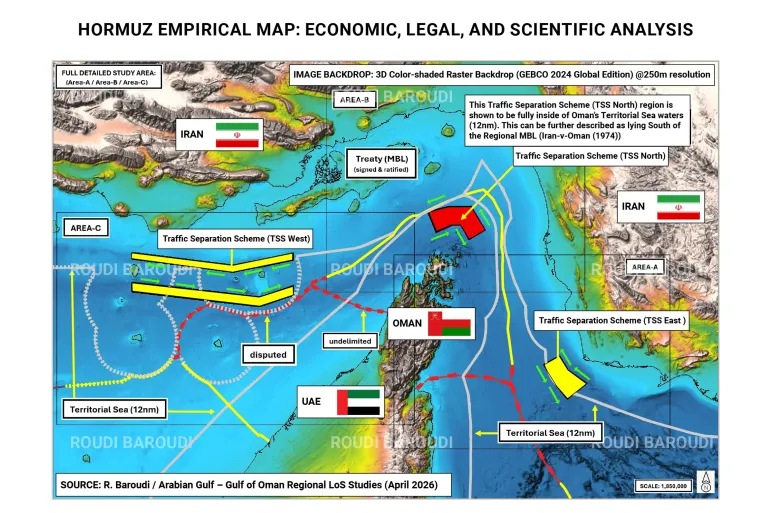
Traffic in the strait is regulated by a Traffic Separation Scheme (TSS) established by the IMO. The TSS in the Strait of Hormuz comprises a separation zone and two traffic lanes for, respectively, westbound and eastbound traffic in the strait.
These special sea lanes are mandatory for merchant vessels transiting the strait. Iran and Oman, which lie on the northern and southern coasts of the strait, respectively, are both IMO member states and, as such, must respect the IMO-mandated shipping lanes in the Hormuz passage.
This area within the Strait of Hormuz (north of the Musandam Peninsula), including the mandatory TSS shipping lanes (depicted in the map below), lies entirely in the territorial waters of Oman, as established through the maritime boundary line agreed in the Iran-Oman treaty of July 25, 1974.
[Courtesy of Roudi Baroudi]
Given that Oman has signed and ratified the UNCLOS, its free transit passage regime applies to its waters and any user state that has ratified the UNCLOS. In this sense, Iran has no jurisdiction over this area in the Strait of Hormuz, as an IMO member state that has signed but not ratified the UNCLOS.
The western end of the strait, where it opens up to traffic inside the Gulf, includes special shipping lanes subject to a mandatory TSS established by the IMO, which are divided into inbound (north) and outbound (south) lanes. Both of these lanes, which are separated by islands, are situated partly in what Iran claims as it waters and partly in undelimited waters disputed between Iran and the United Arab Emirates, as per the Iran-UAE continental shelf agreement of August 31, 1974.
The area used for international shipping lies near the disputed islands Abu Musa and the Greater and Lesser Tunbs. None of this removes or diminishes Iran’s obligation to refrain from interfering or threatening to interfere with those IMO shipping lanes.
The imposition of levies by a state bordering an international strait on vessels passing through it would be incompatible (even illegal) with both the “transit passage” regime under UNCLOS and the “innocent passage” regime under customary international law.
Moving forward
The significance of energy transit choke points through narrow channels cannot be overstated. As one-half of the world’s crude oil supply relies on maritime transportation, protecting the free flow of oil and gas through maritime shipping routes is crucial for global energy price stability and security.
There is an urgent need for durable solutions which necessitate immediate dialogue and diplomacy. As the symbol of the current rules-based order, the United Nations should play a central role in resolving the current situation. Whatever format this process assumes, it should be based on existing international legal provisions and should uphold the rights of all states involved.
The potential gains and benefits of resolving this situation far outweigh any “achievements” perceived in the ongoing disruption of the free passage in the Strait of Hormuz. We all need peace.
The views expressed in this article are the author’s own and do not necessarily reflect Al Jazeera’s editorial stance.
Roudi Baroudi is the auditor of several books about maritime boundaries and has worked in the international energy business since the 1970s. He currently serves as CEO of Energy and Environment Holding, an independent consultancy based in Doha.
Open Letter to H.E. António Guterres, Secretary-General of the United Nations
Posted By
admin
On
In
Adnoc,Aramco,athensenergydialogues,Blue Economy,Business,chemical,China,Clean Energy,Climate,climateaction,climatechange,coronavirus,cyprus,decarbonization,Economy,Energy,energyindustry,Europe,Finance,greece,Hormuz,lebanon,LNG,Maritime Disputes,nuclear,Oil & Gas,Politics,Qatar,qatarenergy,renewableenergy,Roudi Baroudi,russia,Saudi Arabia,Strait of Hormuz,sustainability,Syria,Uncategorized,رودي بارودي |
Comments Disabled
By Roudi Baroudi
Dear Secretary-General Guterres,
I write to thank you for your efforts to bring about a ceasefire in the current conflict pitting the United States and Israel against Iran, to applaud your calls for civilians to be protected, and to urge you in the strongest possible terms to expand and intensify these efforts with all of the tools at your disposal.
People are already dying in countries that have little or nothing to do with the conflict, devastating socioeconomic consequences are spreading around the globe, and conditions can only get worse if current trends continue.
It was inevitable that any prolonged hostilities so close to the Strait of Hormuz would cause energy prices to go up, at least temporarily, because insurance rates would rise at the increased risk of an errant missile or two hitting a supertanker. But that is not what has happened here. Instead, just three weeks into the fighting, the strait is effectively closed to shipping, and global markets for oil and gas are undergoing the worst supply disruption in history. Prices are up sharply, and it will be months or even years before they return to previous levels.
The rapid escalation of the situation has not been due to chance; rather, it is because Iran threatened to directly target shipping in the strait, and several vessels have come under deliberate fire from its forces. These are risks to which most shipping companies will not subject their crews and hulls under any circumstances, not least when the cargo is something as volatile as oil or liquified natural gas (LNG).
Ergo, the strait is closed, meaning that roughly one-fifth of the world’s oil and LNG can no longer reach market, and therefore that two pillars of global economic stability – affordable transport and affordable electricity – are becoming increasingly brittle. In addition, significant percentages of the global trade in other key commodities, including fertilizers, aluminum, helium, polymers, and various forms of chemical feedstock. These are essential to myriad industries everywhere, and to the jobs they provide, everything from agriculture, construction, pharmaceuticals, and food processing to clothing, footwear, heavy industry, and the latest digital technologies.
Even these obstacles could have been overcome, provided the disruption did not persist for too long. And indeed, early releases of strategic oil reserves by the United States (172 million barrels) and members of the International Energy Agency (400 million barrels) initially helped to calm markets when they were announced. This effect soon began to wear off, however, when markets realized that those releases amount to only about a month of usual Hormuz traffic. The United States then found two other cards to play by temporarily “de-sanctioning” Russian oil and an estimated 140 million barrels of Iranian crude currently held in floating storage, helping to alleviate the supply gap and reducing upward pressure on prices.
Sadly, we are beyond that point as well. After Israel attacked Iranian infrastructure associated with the latter’s South Pars gasfield (part of the world’s single largest field and shared with Qatar), Iran’s response was not just to attack Israel’s largest refinery: it also lashed out at energy production and export facilities in several of its Arab neighbors. Refineries, LNG plants, and other assets have now been damaged or destroyed in all six member-states of the Gulf Cooperation Council, which groups Bahrain, Kuwait, Oman, Qatar, Saudi Arabia, and the United Arab Emirates.
I stress here that each of the GCC states is also a full member of the United Nations, and several of them count among the world’s most prolific providers of relief and development assistance, both via UN bodies and through their respective overseas development agencies.
This loss of production capacity constitutes an exponential worsening of the situation, for even if Hormuz were to reopen tomorrow, there is no way to fully compensate for the oil, gas, and other products that have been taken off the market. Delay alone is costly and disruptive, but the destruction of production capacity constitutes a massive step-change because much of it simply cannot be replaced any time soon.
In some cases, repairs may take weeks or months, but others entail more lasting impacts. QatarEnergy says the damage at Ras Laffan, for example, has taken 17% of Qatar’s national LNG capacity offline – and that it will take two or three years to repair. Qatar is the world’s leading exporter of that product, so a long period of elevated gas prices is unavoidable. Of course, several countries have new LNG capacity at various stages of design or construction, including Qatar itself, plus the US, Australia, and Canada. These will help, of course, but not with the current price surge, and even when they do come online, much of their output will already be accounted for.
Mr. Secretary-General,
As catastrophic as these setbacks are, they pale in comparison to what awaits billions of people if current trends continue.
First, consider the GCC countries themselves. They did not ask for this war, several of them expended considerable diplomatic effort trying to prevent it, and yet they are incurring enormous physical and economic damage, not to mention the lives and livelihoods lost. Much of the focus has been on what is no longer coming out of the Gulf, but the GCC states also have to worry what is no longer coming in: this includes most of their food and other essential products, and virtually all of their cars, computers, televisions, and industrial machinery. Of course they can arrange alternative delivery routes, but that will impose significantly higher costs for virtually everything – a burden that will be particularly onerous for the millions of migrant laborers who live in the GCC countries.
These same countries have shown remarkable restraint (thus far) by not retaliating for Iranian missile and drone strikes, but the recent meeting of Arab foreign ministers in Riyadh signaled that this patience is not infinite. These countries cannot be expected to remain on the receiving end of so much underserved devastation without responding in kind, and if and when that happens, the global supply crisis is liable to get even worse.
I stress here that the vast majority of all countries also are members of the United Nations, and many of them are likewise generous contributors to the UN and the developing world. Even many of the poorer ones have made enormous sacrifices in the name of international peace and security, often by sending their troops to act as peacekeepers in some of the world’s most dangerous hotspots.
The interests of all 193 UN member-states are at stake in this war, and most them are looking to the UN for help, guidance, and leadership.
Mr. Secretary-General,
The United Nations is the most important institution in the world today, even and perhaps especially because it has become so fashionable to denigrate it, and because some governments seek to undermine it at every turn. Above all else, the UN was established to prevent war when it can, and to alleviate the resulting human suffering when it cannot. Its ability to do either of these things is being sorely tested these days, particularly since many governments view the rules of the international system as hindrances to be bulldozed or ignored.
Like all supporters of a rules-based order, I recognize that the realities of great-power politics sometimes make it impossible for the UN to impose solutions consistent with both international law and the often nebulous but always noble notion of collective security. But now is no time to accept failure, not when we know that the effects of the current war are going to reach into so many homes around the word, and that this will take place by design.
The United Nations still has options because its remit includes the day-to-day handling of incidents, joint activities, and other interactions that take place between member-states. As such, it is the custodian of several specialized agencies and treaties relating to various aspects of maritime law in peace- and wartime alike, including the International Maritime Organization (IMO) established in 1948, the 1969 Vienna Convention on the Law of Treaties, and the 1982 UN Convention on the Law of the Sea (UNCLOS).
These agencies regulate and otherwise provide a level playing field for all manner of international interactions, and their responsibilities are not suspended during wartime. On the contrary, the UN’s work is never more vital than after the shooting starts, especially when the intended targets of the war’s negative impacts include everyone, everywhere.
The duty to protect civilians during armed conflict is a universal and overriding one, and while many belligerents harm civilians and their interests by accident, Iran’s actions deliberately target the welfare of civilians around the world. The United Nations is the ultimate forum for the resolution of disputes great and small, and even when governments choose to ignore it, the UN remains bound by its Charter to seek peace and security.
Most importantly, never stop reminding the belligerents of their obligations under the UN Charter, particularly when they fail to live up to them. Call out Iran for inter alia, having illegally interfered in the innocent transit of civilian shipping, which is specifically protected within straits, even in wartime, by IMO & UNCLOS – and therefore for weaponizing energy and turning it on the whole world.
Diplomacy takes place on multiple levels, from public statements and backchannel communications to purely procedural exchanges and informal trust-building exercises. In the current circumstances, given how many people are being affected, no stone can be left unturned in convincing Iran to stop choking out the global economy, or in convincing its opponents to cease fire.
Finally, I would note that when the belligerents are unwilling to consider dialogue or other alternatives to conflict, that is precisely when the good offices and moral authority of the United Nations are needed most. Now is no time to let them fight it out, not when the welfare of billions of people is at stake.
رسالة مفتوحة إلى سعادة الأمين العام للأمم المتحدة السيد أنطونيو غوتيريش المحترم،
Posted By
admin
On
In
Adnoc,Aramco,athensenergydialogues,Blue Economy,Business,chemical,China,Clean Energy,Climate,climateaction,climatechange,coronavirus,cyprus,decarbonization,Economy,Energy,energyindustry,Europe,Finance,greece,Hormuz,lebanon,LNG,Maritime Disputes,nuclear,Oil & Gas,Politics,Qatar,qatarenergy,renewableenergy,Roudi Baroudi,russia,Saudi Arabia,Strait of Hormuz,sustainability,Syria,Uncategorized,رودي بارودي |
Comments Disabled
سعادة السيد أنطونيو غوتيريش
الأمين العام للأمم المتحدة،
نيويورك، NY 10017 الولايات المتحدة الأميركية
22 مارس 2026
رسالة مفتوحة إلى سعادة الأمين العام للأمم المتحدة السيد أنطونيو غوتيريش المحترم،
• رسالة إلى الأمين العام للأمم المتحدة: تحركوا الآن قبل فوات الأوان… إغلاق هرمز… بداية أزمة قد تغيّر العالم.
حضرة الأمين العام ،
أكتب إليكم لأعرب عن شكري لجهودكم الرامية إلى التوصل إلى وقف لإطلاق النار في النزاع الحالي بين الولايات المتحدة وإسرائيل من جهة وإيران من جهة أخرى، ولأثني على دعواتكم لحماية المدنيين، ولأحثكم بأشد العبارات على توسيع هذه الجهود وتكثيفها باستخدام جميع الأدوات المتاحة لديكم.
الناس يموتون بالفعل في دول لا علاقة لها تُذكر بالنزاع، كما أن التداعيات الاجتماعية والاقتصادية المدمرة تنتشر في جميع أنحاء العالم، ولا يمكن للأوضاع إلا أن تزداد سوءًا إذا استمرت الاتجاهات الحالية.
كان من الحتمي أن تؤدي أي أعمال عدائية مطوّلة بالقرب من مضيق هرمز إلى ارتفاع أسعار الطاقة، ولو بشكل موقت، بسبب زيادة تكاليف التأمين نتيجة ارتفاع مخاطر إصابة ناقلات النفط العملاقة بصواريخ طائشة. لكن هذا ليس ما حدث مع هذه الحرب. فبعد ثلاثة أسابيع فقط من اندلاع القتال، أصبح المضيق مغلقًا فعليًا أمام الملاحة، وتواجه الأسواق العالمية للنفط والغاز أسوأ اضطراب في الإمدادات في التاريخ. ما أدى الى ارتفاع الأسعار بشكل حاد، ومن المرجح أن يستغرق الأمر شهورًا أو حتى سنوات قبل أن تعود إلى مستوياتها السابقة.
إن التصعيد السريع للوضع لم يكن نتيجة للصدفة؛ بل جاء نتيجة تهديد إيران باستهداف الملاحة في المضيق بشكل مباشر، وقد تعرّضت عدة سفن بالفعل لنيران متعمدة من قبل قواتها. وهذه المخاطر لا تقبل معظم شركات الشحن تعريض طواقمها وسفنها لها تحت أي ظرف، لا سيما عندما تكون الحمولة مواد شديدة الحساسية مثل النفط أو الغاز الطبيعي المسال.
نتبجة لذلك، أصبح المضيق مغلقًا، ما يعني أن نحو خُمس إمدادات النفط والغاز الطبيعي المسال في العالم لم تعد تصل إلى الأسواق، وهو ما يؤدي إلى تآكل ركيزتين أساسيتين من ركائز الاستقرار الاقتصادي العالمي، وهما النقل العادي التكلفة والكهرباء ذات التكلفة العادية. وإضافة إلى ذلك، فإن نسبًا كبيرة من التجارة العالمية من سلع أساسية أخرى- بما في ذلك الأسمدة، والألمنيوم، والهيليوم، والبوليمرات، ومختلف المواد الكيميائية الأولية – تتأثر أيضًا. ومن المعروف إن هذه مواد أساسية لعدد لا يُحصى من الصناعات حول العالم، وللوظائف التي توفرها، بدءًا من الزراعة والبناء والصناعات الدوائية وتصنيع الأغذية، وصولًا إلى الملابس والأحذية والصناعات الثقيلة وأحدث التقنيات الرقمية.
كان من الممكن التغلب على هذه العقبات، لو لم يستمر هذا الاضطراب لفترة طويلة. وبالفعل، ساهمت عمليات الإفراج المبكرة عن الاحتياطيات النفطية الاستراتيجية من قبل الولايات المتحدة (172 مليون برميل) وأعضاء وكالة الطاقة الدولية (400 مليون برميل) في تهدئة الأسواق في البداية. غير أن هذا التأثير بدأ يتلاشى عندما أدركت الأسواق أن هذه الكميات لا تعادل سوى نحو شهر واحد من حركة المرور المعتادة عبر مضيق هرمز. ثم لجأت الولايات المتحدة إلى خيارين إضافيين تمثلا في تخفيف موقت للعقوبات على النفط الروسي، والسماح بطرح نحو 140 مليون برميل من النفط الإيراني المخزن عائمًا، ما ساهم في تقليص فجوة الإمدادات والحد من الضغوط التصاعدية على الأسعار.
ومع الأسف، فقد تجاوزنا هذه المرحلة أيضًا. فبعد أن استهدفت إسرائيل بنى تحتية إيرانية مرتبطة بحقل غاز جنوب فارس (وهو جزء من أكبر حقل غاز في العالم ويُشترك فيه مع قطر)، لم يقتصر رد إيران على مهاجمة أكبر مصفاة في إسرائيل، بل امتد ليشمل استهداف منشآت إنتاج وتصدير الطاقة في عدد من جيرانها العرب. وقد تعرضت مصافٍ ومنشآت للغاز الطبيعي المسال وغيرها من الأصول للتدمير أو الأضرار في جميع الدول الست الأعضاء في مجلس التعاون لدول الخليج العربي، وهي البحرين والكويت وعُمان وقطر والمملكة العربية السعودية والإمارات العربية المتحدة.
أود التأكيد هنا أن جميع دول مجلس التعاون همي أيضًا أعضاء كاملة في الأمم المتحدة، وأن عددًا منها يُعد من أبرز مقدمي المساعدات الإنسانية والتنموية في العالم، سواء عبر هيئات الأمم المتحدة أو من خلال وكالاتها التنموية.
إن فقدان هذه القدرات الإنتاجية يمثل تدهورًا متسارعًا وخطيرًا للوضع؛ فحتى لو أُعيد فتح مضيق هرمز غدًا، فلن يكون بالإمكان تعويض كامل كميات النفط والغاز وغيرها من المنتجات التي خرجت من السوق. فالتأخير وحده مكلف ومُربك، لكن تدمير القدرة الإنتاجية يمثل تحولًا جذريًا، لأن الكثير منها لا يمكن استبداله في وقت قريب.
وفي بعض الحالات، قد تستغرق الإصلاحات أسابيع أو أشهرًا، لكن في حالات أخرى تكون التأثيرات طويلة الأمد. فعلى سبيل المثال، أفادت شركة قطر للطاقة بأن الأضرار التي لحقت بمنشآت رأس لفان أدت إلى توقف 17 % من القدرة الوطنية لإنتاج الغاز الطبيعي المسال، وأن إصلاحها قد يستغرق عامين إلى ثلاثة أعوام. ونظرًا لأن قطر هي أكبر مصدر عالمي للغاز الطبيعي، فإن فترة طويلة من ارتفاع أسعار الغاز أصبحت أمرًا لا مفر منه. وبالطبع، هناك دول عدة تعمل على تطوير قدرات جديدة في هذا المجال، مثل قطر نفسها والولايات المتحدة وأستراليا وكندا، غير أن هذه المشاريع لن تُسهم في معالجة الأزمة الحالية، وحتى عند دخولها الخدمة، سيكون جزء كبير من إنتاجها قد تم التعاقد عليه مسبقًا.
حضرة الأمين العام،
على الرغم من جسامة هذه التحديات، فإنها تبدو ضئيلة مقارنة بما قد يواجه مليارات البشر إذا استمرت الاتجاهات الحالية.
ففي المقام الأول، ينبغي النظر إلى دول مجلس التعاون نفسها. فهي لم تطلب هذه الحرب، وقد بذلت عدة دول منها جهودًا دبلوماسية كبيرة لمنعها، ومع ذلك تتكبد أضرارًا مادية واقتصادية جسيمة، فضلًا عن الخسائر في الأرواح وسبل العيش. وبينما ينصب التركيز على ما لم يعد يخرج من الخليج، فإن هذه الدول تواجه أيضًا مشكلة في ما لم تعد تستطيع استيراده، بما في ذلك معظم احتياجاتها من الغذاء والسلع الأساسية، وكذلك معظم السيارات والحواسيب وأجهزة التلفاز والآلات الصناعية. بإمكانها بالطبع إيجاد طرق بديلة للإمداد، لكن ذلك سيؤدي إلى ارتفاع كبير في التكاليف، وهو عبء سيكون أشد وطأة على ملايين العمال الوافدين المقيمين في هذه الدول.
أظهرت هذه الدول حتى الآن قدرًا كبيرًا من ضبط النفس بعدم الرد على الهجمات الصاروخية والطائرات المسيّرة الإيرانية، إلا أن الاجتماع الأخير لوزراء الخارجية العرب في الرياض أشار إلى أن لهذا الصبر حدودًا. ولا يمكن توقع استمرار هذه الدول في تحمل هذا القدر من الدمار دون رد، وإذا حدث ذلك، فمن المرجح أن تتفاقم أزمة الإمدادات العالمية.
كما أؤكد هنا أن الغالبية العظمى من دول العالم هي أيضًا أعضاء في الأمم المتحدة، وأن العديد منها يسهم بسخاء في دعمها ودعم الدول النامية. بل إن حتى الدول الأقل دخلًا قدمت تضحيات كبيرة في سبيل السلم والأمن الدوليين، من خلال إرسال قواتها للمشاركة في مهام حفظ السلام في أكثر مناطق العالم خطورة.
إن مصالح جميع الدول الأعضاء الـ 193 في الأمم المتحدة على المحك في هذه الحرب، ومعظمها يتطلع إلى الأمم المتحدة طلبًا للمساعدة والتوجيه والقيادة.
حضرة الأمين العام،
تُعد الأمم المتحدة أهم مؤسسة في العالم اليوم، وربما بشكل خاص بسبب ما تتعرض له من انتقادات ومحاولات تقويض. فقد أُنشئت أساسًا لمنع الحروب متى أمكن، وللتخفيف من معاناة البشر عندما يتعذر ذلك. واليوم، تواجه قدرتها على أداء هذين الدورين اختبارًا صعبًا، خاصة في ظل تجاهل بعض الحكومات قواعد النظام الدولي.
ومثل غيري من الداعمين لقيام نظام قائم على القواعد، أدرك أن واقع سياسات القوى الكبرى قد يجعل من الصعب على الأمم المتحدة فرض حلول تتوافق تمامًا مع القانون الدولي ومفهوم الأمن الجماعي. لكن هذا ليس وقت الاستسلام، لا سيما وأن آثار هذه الحرب ستطول عددًا هائلًا من البشر حول العالم.
ولا تزال لدى الأمم المتحدة خيارات، نظرًا لمسؤولياتها في إدارة التفاعلات اليومية بين الدول الأعضاء، بما في ذلك عبر وكالاتها المتخصصة والاتفاقيات المتعلقة بالقانون البحري، مثل المنظمة البحرية الدولية، واتفاقية فيينا لقانون المعاهدات لعام 1969، واتفاقية الأمم المتحدة لقانون البحار لعام 1982.
هذه الهيئات تنظم التفاعلات الدولية حتى في أوقات الحرب، من المعروف أن دور الأمم المتحدة يصبح أكثر أهمية بعد اندلاع النزاعات، خاصة عندما تمتد آثارها بشكل واسع.
إن حماية المدنيين أثناء النزاعات المسلحة واجب عالمي لا يقبل التهاون، وبينما تقع أضرار على المدنيين أحيانًا بشكل غير مقصود، فإن بعض الأفعال تستهدفهم عمدًا. وتظل الأمم المتحدة المنصة الأهم لحل النزاعات، وهي ملزمة بالسعي لتحقيق السلم والأمن.
والأهم من ذلك، يجب عدم التوقف عن تذكير أطراف النزاع بالتزاماتهم بموجب ميثاق الأمم المتحدة، لا سيما عند الإخلال بها. كما يجب إدانة أي تدخل غير قانوني في حرية الملاحة المدنية، خصوصًا في المضائق الدولية، وتحويل الطاقة إلى أداة ضغط على العالم.
إن الدبلوماسية تتم على مستويات متعددة، من التصريحات العلنية إلى القنوات الخلفية، وفي ظل الظروف الحالية، لا بد من استخدام كل الوسائل الممكنة لإقناع الأطراف بوقف التصعيد.
وأخيرًا، فإن اللحظة التي يرفض فيها المتحاربون الحوار هي تحديدًا اللحظة التي تبرز فيها أهمية دور الأمم المتحدة وسلطتها الأخلاقية. وليس من المقبول ترك النزاع يتفاقم بينما مصير مليارات البشر على المحك.
مع خالص التقدير، رودي بارودي
رودي بارودي الرئيس التنفيذي لشركة “إينرجي آند إنفايرونمنت هولدينغ”، وهي شركة استشارية مستقلة مقرها الدوحة. حاز على جائزة القيادة لعام 2024 من شبكة القيادة عبر الأطلسي تقديرًا لجهوده في تعزيز الحوار والسلام في منطقة شرق المتوسط.