Iraq voices frustration with Opec days before crunch meeting

Bloomberg/London

Iraq’s deputy leader has criticised Opec just days before the oil group makes a crucial decision on whether to raise output.
Opec should take members’ economic and political conditions into account when deciding production quotas rather than adopting a “one-size-fits-all” approach, according to Ali Allawi, Iraq’s Finance and Deputy Prime Minister.
“We have reached the limit of our ability and willingness to accept a policy of one size fits all,” he said this week during a virtual conference hosted by UK think-tank Chatham House. “It has to be more nuanced and it has to be related to the per-capita income of people, the presence of sovereign wealth funds, none of which we have. We are beginning to articulate this position.”
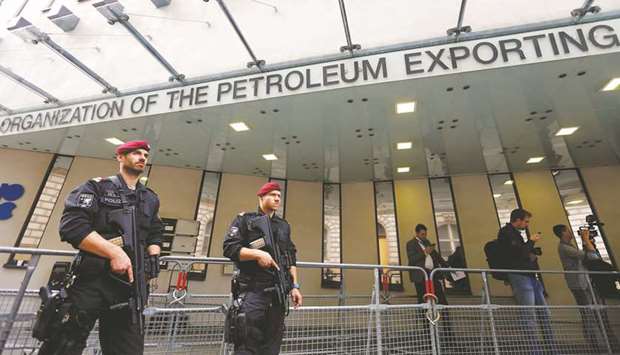
While Allawi said he wasn’t speaking on behalf of the Ministry of Oil, which decides on Opec matters, his comments are yet another manifestation of rifts within the group before its next meeting on November 30. Nigeria also has tried to get some oil blends excluded from its quota.
Iraq, the group’s biggest producer after Saudi Arabia, is reeling from the coronavirus-triggered collapse in oil prices. While all members have suffered, Iraq’s position is about the worst of the lot, with the government struggling to pay teachers and civil servants, and protesters taking to the streets en masse.
Opec+, an alliance between the Organization of Petroleum Exporting Countries and others such as Russia, meets a day later, on December 1. It agreed in April, at the height of the pandemic, to cut crude output by almost 10mn barrels daily. Opec imposed quotas on 10 of its 13 members, exempting Iran, Libya and Venezuela because of their economic and political turmoil.
Opec+ eased some of those curbs in August. It was meant to reduce the cuts by another 2mn barrels daily at the start of January, but renewed lockdowns in major economies including the US and Europe mean that some members may push for a delay.
Brent crude prices have more than doubled since April, but are still down around 26% this year at $48.50 a barrel.
Iraq has already breached its quota on several occasions. It has promised to compensate for its over-production. This week, in an unprecedented move, Iraq sought an upfront payment of about $2bn in exchange for a long-term crude-supply contract.


China is set to eclipse US as world’s biggest oil refiner

Bloomberg/Beijing

Earlier this month, Royal Dutch Shell pulled the plug on its Convent refinery in Louisiana. Unlike many oil refineries shut in recent years, Convent was far from obsolete: It’s fairly big by US standards and sophisticated enough to turn a wide range of crude oils into high-value fuels. Yet Shell, the world’s third-biggest oil major, wanted to radically reduce refining capacity and couldn’t find a buyer.
As Convent’s 700 workers found out they were out of a job, their counterparts on the other side of Pacific were firing up a new unit at Rongsheng Petrochemical’s giant Zhejiang complex in northeast China. It’s just one of at least four projects underway in the country, totalling 1.2mn barrels a day of crude-processing capacity, equivalent to the UK’s entire fleet.
The Covid crisis has hastened a seismic shift in the global refining industry as demand for plastics and fuels grows in China and the rest of Asia, where economies are quickly rebounding from the pandemic. In contrast, refineries in the US and Europe are grappling with a deeper economic crisis while the transition away from fossil fuels dims the long-term outlook for oil demand.
America has been top of the refining pack since the start of the oil age in the mid-nineteenth century, but China will dethrone the US as early as next year, according to the International Energy Agency. In 1967, the year Convent opened, the US had 35 times the refining capacity of China.
The rise of China’s refining industry, combined with several large new plants in India and the Middle East, is reverberating through the global energy system. Oil exporters are selling more crude to Asia and less to long-standing customers in North America and Europe. And as they add capacity, China’s refiners are becoming a growing force in international markets for gasoline, diesel and other fuels. That’s even putting pressure on older plants in other parts of Asia: Shell also announced this month that they will halve capacity at their Singapore refinery.
There are parallels with China’s growing dominance of the global steel industry in the early part of this century, when China built a clutch of massive, modern mills. Designed to meet burgeoning domestic demand, they also made China a force in the export market, squeezing higher-cost producers in Europe, North America and other parts of Asia and forcing the closure of older, inefficient plants.
“China is going to put another million barrels a day or more on the table in the next few years,” Steve Sawyer, director of refining at industry consultant Facts Global Energy, or FGE, said in an interview. “China will overtake the US probably in the next year or two.”
But while capacity will rise is China, India and the Middle East, oil demand may take years to fully recover from the damage inflicted by the coronavirus. That will push a few million barrels a day more of refining capacity out of business, on top of a record 1.7mn barrels a day of processing capacity already mothballed this year. More than half of these closures have been in the US, according to the IEA.
About two thirds of European refiners aren’t making enough money in fuel production to cover their costs, said Hedi Grati, head of Europe-CIS refining research at IHS Markit. Europe still needs to reduce its daily processing capacity by a further 1.7mn barrels in five years.
“There is more to come,” Sawyer said, anticipating the closure of another 2mn barrels a day of refining capacity through next year.
Chinese refining capacity has nearly tripled since the turn of the millennium as it tried to keep pace with the rapid growth of diesel and gasoline consumption. The country’s crude processing capacity is expected to climb to 1bn tons a year, or 20mn barrels per day, by 2025 from 17.5mn barrels at the end of this year, according to China National Petroleum Corp’s Economics & Technology Research Institute.
India is also boosting its processing capability by more than half to 8mn barrels a day by 2025, including a new 1.2mn barrels per day mega project. Middle Eastern producers are adding to the spree, building new units with at least two projects totalling more than a million barrels a day that are set to start operations next year.
One of the key drivers of new projects is growing demand for the petrochemicals used to make plastics. More than half of the refining capacity that comes on stream from 2019 to 2027 will be added in Asia and 70% to 80% of this will be plastics-focused, according to industry consultant Wood Mackenzie.
The popularity of integrated refineries in Asia is being driven by the region’s relatively fast economic growth rates and the fact that it’s still a net importer of feedstocks like naphtha, ethylene and propylene as well as liquefied petroleum gas, used to make various types of plastic. The US is a major supplier of naphtha and LPG to Asia.
These new massive and integrated plants make life tougher for their smaller rivals, who lack their scale, flexibility to switch between fuels and ability to process dirtier, cheaper crudes.
The refineries being closed tend to be relatively small, not very sophisticated and typically built in the 1960s, according to Alan Gelder, vice president of refining and oil markets at Wood Mackenzie. He sees excess capacity of around 3mn barrels a day. “For them to survive, they will need to export more products as their regional demand falls, but unfortunately they’re not very competitive, which means they’re likely to close.”
Global oil consumption is on track to slump by an unprecedented 8.8mn barrels a day this year, averaging 91.3mn a day, according to the IEA, which expects less than two-thirds of this lost demand to recover next year.
Some refineries were set to shutter even before the pandemic hit, as a global crude distillation capacity of about 102mn barrels a day far outweighed the 84mn barrels of refined products demand in 2019, according to the IEA. The demand destruction due to Covid-19 pushed several refineries over the brink.
“What was expected to be a long, slow adjustment has become an abrupt shock,” said Rob Smith, director at IHS Markit.
Adding to the pain of refiners in the US are regulations pushing for biofuels. That encouraged some refiners to repurpose their plants for producing biofuels.
Even China may be getting ahead of itself. Capacity additions are outpacing its demand growth. An oil products oversupply in the country may reach 1.4mn barrels a day in 2025, according to CNPC. Even as new refineries are built, China’s demand growth may peak by 2025 and then slow as the country begins its long transition toward carbon neutrality.


Lebanon sets starting point for sea border negotiations with Israel

BEIRUT (Reuters) – President Michel Aoun on Thursday specified Lebanon’s starting point for demarcating its sea border with Israel under U.S.-mediated talks, in the first public confirmation of a stance sources say increases the size of the disputed area.

Israel and Lebanon launched the negotiations last month with delegations from the long-time foes convening at a U.N. base to try to agree on the border that has held up hydrocarbon exploration in the potentially gas-rich area.

A presidency statement said Aoun instructed the Lebanese team that the demarcation line should start from the land point of Ras Naqoura as defined under a 1923 agreement and extend seaward in a trajectory that a security source said extends the disputed area to some 2,300 square km (888 sq miles) from around 860 sq km.

Israel’s energy minister, overseeing the talks with Lebanon, said Lebanon had now changed its position seven times and was contradicting its own assertions.

“Whoever wants prosperity in our region and seeks to safely develop natural resources must adhere to the principle of stability and settle the dispute along the lines that were submitted by Israel and Lebanon at the United Nations,” Yuval Steinitz said.

Any deviation, Steinitz said, would lead to a “dead end”.

Last month sources said the two sides presented contrasting maps for proposed borders. They said the Lebanese proposal extended farther south than the border Lebanon had years before presented to the United Nations and that of the Israeli team pushed the boundary farther north than Israel’s original position.

The talks, the culmination of three years of diplomacy by Washington, are due to resume in December.

Israel pumps gas from huge offshore fields but Lebanon, which has yet to find commercial gas reserves in its own waters, is desperate for cash from foreign donors as it faces the worst economic crisis since its 1975-1990 civil war.

Additional reporting by Ari Rabinovitch in Jerusalem; Writing by Ghaida Ghantous; Editing by Janet Lawrence


Athens responds to US State Department’s claim that Greek air space is only 6 nautical miles

Regarding the report by the US State Department, which was forwarded to the US Congress on March 18 and in the framework of the provisions of the “Eastern Mediterranean Security and Energy Partnership Act,” diplomatic sources pointed out that the borders of Greece’s territorial waters, as well as the maritime borders between Greece and Turkey, have been clearly defined for years on the basis of international law and are not in any dispute.

In particular, they stated in response to the State Department that regarding the Southeastern Aegean and the Eastern Mediterranean, the maritime borders have been defined by the Italy-Turkey Agreement signed in Ankara on 4 January 1932, as well as the minutes which was signed in Ankara on December 28, 1932.

Greece, as the successor state under the Treaty of Paris of 1947, gained sovereignty over the Dodecanese without any change in the maritime borders, as agreed between Italy and Turkey.

Regarding the sea borders in Thrace (up to the point of a distance of three nautical miles from the Evros Delta), they emphasise that these were defined by the Treaty of Lausanne of 1923 and the Athens Protocol of 1926.

Finally, regarding the sea borders between the above two areas (from Thrace to Dodecanese), where the territorial waters of Greece and Turkey intersect, they pointed out that the sea borders follow the middle line between the Greek islands and islets and the opposite Turkish coasts.

The same diplomatic sources noted that Greece’s external borders, including its territorial waters, are at the same time the external borders of the European Union.

The recently released State Department report states that Greece claims an airspace that extends up to 10 nautical miles and a territorial sea of up to 6 nautical miles, but that “under international law, a country’s airspace coincides with its territorial sea.”

“The US thus recognizes an airspace up to 6 nautical miles consistent with territorial sea. Greece and the US do not share a view on the extent of Greece’s airspace,” the report said.

The State Department report adds that although Athens currently claims up to a 6-nautical-mile territorial sea in the Aegean, “Greece and its neighbors have not agreed on boundary delimitation in those areas where their lawful maritime entitlements overlap.”

“Lack of such delimitation means there is no clarity on the extent of Greece’s territorial sea and corresponding airspace in these areas rendering any assessment of total violations not feasible,” the report said.

The State Department report said Washington encourages Greece and Turkey “to resolve outstanding bilateral maritime boundary issues peacefully and in accordance with international law.”


Nakilat completes second phase of fleet management transition

Qatar-based shipping and maritime company Nakilat has completed the second phase of its fleet management transition from Shell International Trading and Shipping Company.

A total of seven liquefied natural gas (LNG) carriers transitioned to its in-house operational and technical management.

During the second phase transition, Q-Max LNG carrier Lijmiliya was the last vessel to transition from Shell to Nakilat Shipping Qatar Limited (NSQL) on 27 October.

Currently, the fleet size fully managed by NSQL stands at 26 vessels with 22 LNG vessels and four liquefied petroleum gas (LPG) carriers.

Over the past several years, Nakilat has been working closely with its long-term partner Shell for a smooth transition of vessel management.

Nakilat CEO Abdullah Fadhalah Al Sulaiti said: “This milestone achieved in a safe and timely manner, despite the challenges presented by the global pandemic, is especially meaningful and demonstrates our strong commitment to safety, reliability, and efficiency through the provision of quality shipping and maritime services.”

Al Sulaiti continued: “Over the past years, Nakilat has grown in leaps and bounds with the steady expansion of its LNG fleet, which is the largest in the world. The management of our vessels centrally controlled from Qatar allows us to further capitalise on existing synergies with our main charterer (Qatargas), realise operational efficiencies, and optimise costs. I would also like to express our gratitude to Qatargas for their cooperation and the continuous support provided throughout our long-term strategic partnership and the entire vessel transition phases.

“We strive to steer forward through tactfully formulated strategies, seizing potential long-term growth opportunities, strengthening ship management capabilities, and enhancing operational excellence in our vision to be a global leader and provider of choice for energy transportation and maritime services.”

Phase one of the fleet management transition, involving ten LNG carriers, began in 2016 and was completed in August 2017.

In a separate development, 11 projects were inaugurated in Iran’s Anzali Port in the Caspian Sea.

Among the projects inaugurated, there is a grain depot with 50,000t capacity and a general cargo warehouse with an area of 4,509m².


Qatar gas delivers first LNG cargo on Q-Max vessel to Tianjin Terminal in China.

Qatargas Operating Company Limited (Qatargas) announced today the delivery of the first cargo of liquefied natural gas (LNG) on a Q-Max LNG carrier to the Tianjin LNG Receiving Terminal in China.

The cargo aboard the Qatargas-chartered LNG vessel, ‘Al Mafyar,’ was loaded at Ras Laffan on 21 October 2020 and delivered to the Tianjin Terminal, located in the northern port city of Tianjin, near Beijing, on 10th November 2020.

This is the first cargo discharge operation by Qatargas to this LNG terminal involving a Q-Max LNG carrier. The Q-Max is the largest LNG vessel class in the world and has the ability to deliver 266,000 cubic metres of LNG.

The Tianjin LNG Receiving Terminal is owned and operated by the China Petroleum & Chemical Corporation (Sinopec), one of China’s largest state-owned enterprises. The terminal has a capacity of six million tonnes per annum (MTPA) and is currently being expanded to handle up to 10.8 MTPA by 2022. The Tianjin LNG receiving terminal received its first LNG cargo in February 2018 and has received more than 200 LNG cargoes so far.

Currently China has a total of 22 LNG receiving terminals (including 3 small scale terminals), 11 of which can accommodate Q-Max LNG vessels. Qatargas has to date delivered LNG cargoes to 13 LNG terminals in China. Ever since the first LNG cargo was delivered to China in September 2009, more than 62 million tonnes of LNG was delivered to China in total.

Al Mafyar is the first Q-Max LNG vessel to call at the Tianjin LNG receiving terminal and the 100th LNG vessel to call at the terminal in 2020.
Source: Qatargas


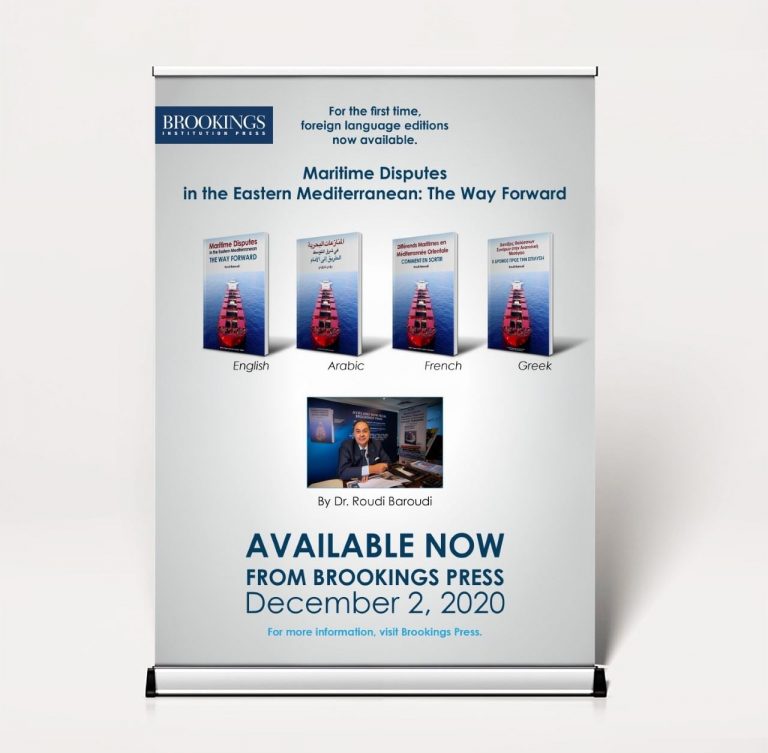
Maritime Disputes in the Eastern Mediterranean: The Way Forward by Dr. Roudi Baroudi

Now available in English at Brookings Institution Press.
Coming soon in Arabic, French, and Greek.

Using satellite imagery, international law, and geodesic research, Roudi Baroudi walks readers through a road map for peaceful and responsible resolution of maritime boundary disputes in the Eastern Mediterranean. The volume draws upon the United Nations and its associated treaties, courts, and other institutions that have developed bodies of law and procedures to facilitate negotiation. Dr. Baroudi points to rapid advances of science and technology as the means to take the guesswork out of boundary delineation, making this route more reliable and user-friendly than ever before.

An expert commentary and seminal work.”
– Ambassador John B. Craig, Senior Fellow, Transatlantic Leadership Network; former Special Assistant to President George W. Bush for Combatting Terrorism, and former United States Ambassador to Oman

Baroudi makes a powerful case for compromise so that the states of the region can move beyond their costly disputes and reap the rewards of cooperation. Dr. Baroudi’s approach has much to teach us and will hopefully contribute to peaceful progress, if only the opposing sides will listen.
– Andrew Novo, Associate Professor of Strategic Studies at the National Defense University

…The countries of the region, as well as the United States and the European Union, should embrace Baroudi’s approach to reduce frictions and realize the benefits of this energy bounty.
– Douglas Hengel, Professional Lecturer in the Energy, Resources and Environment Program Johns Hopkins University, SAIS and Senior Fellow at the German Marshall Fund


Order a copy


Opec+ gets scant relief from vaccine as ministers meet

Bloomberg/London

Oil markets may be cheering the prospects of a coronavirus vaccine, but Opec+ can’t celebrate. Crude prices have rallied to a 10-week high on hopes that Pfizer Inc and BioNTech SE’s breakthrough could soon revive the flights, car journeys and other economic activity that underpin fuel consumption.
Nonetheless, the alliance of producers is discussing a delay of the supply boost they’d hoped to make in January. Oil demand is currently suffering a fresh blow from a resurgence of the pandemic.
Ministers are focused on a postponement of three to six months, according to delegates familiar with the talks who asked not to be identified. They’ll hold an interim meeting on Tuesday to review the market, then make a final decision in a further two weeks.

Frightening pullback
“This is the wrong time to be increasing crude supply,” Bob McNally, president of consultant Rapidan Energy Group and a former White House official, said in a Bloomberg television interview. “They really almost have no choice now but to postpone. The demand pullback in Europe is frightening.”
While the vaccine progress relieves some of the pressure on the Organization of Petroleum Exporting Countries, it won’t provide a significant boost to demand until the second half of 2021 next year, according to the International Energy Agency in Paris. Economic fallout from the latest wave of lockdowns will linger, Opec said in a report. The 23-nation alliance had intended to ease some of the unprecedented supply curbs introduced in May to offset the collapse in demand, restoring 2mn barrels a day of output at the start of next year. They made a similar increase over the summer as the global economy recovered, and hoped that the trend would continue.
But in recent weeks Opec+ members have acknowledged those aspirations look unfeasible. Instead, the producers look set to keep about 7.7mn barrels a day – roughly 8% of global supply – off-line for a little longer.

Critical cut
Deferring the supply boost – and thus supporting prices – may be critical for Opec+ nations, many of which need oil prices far above the current level of $43 a barrel in order to cover government spending. It would also throw a lifeline to the wider industry, from majors like Exxon Mobil Corp to independent companies in the US shale patch.
Saudi Arabian energy minister said on November 9 the producers can “tweak this agreement” as required. Algeria, which holds Opec’s rotating presidency, and group secretary-general Mohammad Barkindo made similar remarks.
Even Russia, usually reluctant to forego oil sales, has signaled support. President Vladimir Putin said on October 22 that delay was an option, and even gestured at the possibility of making deeper production cuts if necessary. Further curbs don’t appear needed so far, delegates say. “The lockdowns in Europe and what that will mean for demand will be very much on their mind,” Daniel Yergin, vice chairman at IHS Markit, said in a Bloomberg Television interview. “The easiest thing for them to do, and as President Putin signalled, is to roll it over.”
While the Joint Ministerial Monitoring Committee that convenes on Tuesday won’t set policy, Riyadh and Moscow may give some insight into their thinking before the main ministerial meetings on November 30 to December 1.

Supply headache
Faltering demand isn’t the only headache for the alliance, which is also having to reckon with a surprising increase in supply from one of its own members.
Libya, which is exempt from the agreement to restrain production, has revived output to the highest level in almost a year after a truce in its civil war. The North African nation tripled supply to 450,000 barrels a day last month, and is now pumping above 1 million a day.
The case for extending curbs, though persuasive, could still run into opposition.
One flash-point may be the millions of barrels of outstanding cuts still due from some members, which were supposed to be completed by the end of the year.
Opec+ nations that flouted their output quotas in the initial months of the agreement, such as Iraq and Nigeria, have been tasked with “compensation cuts.” After making some tentative efforts at these, Baghdad defiantly ramped exports back up last month.


GECF ministers upbeat on natural gas outlook despite pandemic

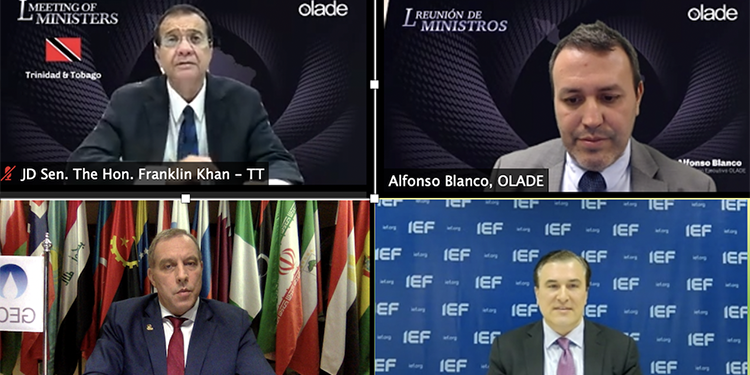
The full promise of natural gas will unfold once the world is past the coronavirus pandemic, upbeat energy ministers of the leading gas exporting countries said at a recent GECF ‘Ministerial Roundtable’ held virtually
The full promise of natural gas will unfold once the world is past the coronavirus pandemic, upbeat energy ministers of the leading gas exporting countries said at a GECF Ministerial Roundtable held recently.
Natural gas is available in abundance, flexible enough to reach far-flung corners of the globe and less polluting to the environment.
As a sideline event to the 22nd Ministerial Meeting held under the auspices of Algeria recently, the virtual dialogue aimed to confront the array of challenges brought on by Covid-19 and the opportunities that are expected to propel natural gas to the top of the global energy mix by 2050.
The gathering of policymakers from the 20-member grouping featured two separate themes of short- and long-term perspectives, with the first session held under the title of “Natural gas in a post-Covid-19 world: A short-term view”, and the second entitled “Natural gas: a transition fuel or a destination?”
The first session was moderated by Stuart Elliot (S&P Global Platts) while Dr Bassam Fattouh (Oxford Institute for Energy Studies) was the second session moderator.
In his opening speech, Abdelmadjid Attar, Minister of Energy of Algeria, said, “I wish to underline the important role of natural gas in satisfying world energy needs. Natural gas is widely available. It is clean. It improves air quality, emits much less carbon dioxide than coal. It is flexible. These qualities of natural gas are recognised by many, if not all”
Attar, whose country is regarded as a pioneer in LNG with the first liquefaction plant commissioning in Arzew, Algeria in 1964, considered access to modern energy and protection of environment as two pressing issues.
“We need to ensure that the pandemic will not hinder progress on these two challenges. I wish to encourage the gas industry to strengthen its efforts in dealing with the issue of methane emission. This is important for natural gas to play a more important role in the energy transition that the world has engaged in,” explained Attar, while adding that Algeria’s vast gas resource will witness $20bn worth of investment in the next years.
GECF secretary general Yury Sentyurin advanced these comments by noting that natural gas is an energy option that achieves a harmonious balance between the environmental, social, and economic dimensions of sustainable development.
“GECF members are committed to strengthen global energy security as reliable suppliers of natural gas in order to meet the world’s growing energy demand. They showcased remarkable determination in their fulfilment of all contractual obligations to the customers. This indicates confidence in the strength of their economies and abilities to absorb major economic crises, notwithstanding numerous challenges and decline in revenues,” Sentyurin noted.
GECF’s Global Gas Outlook 2050 shows natural gas is growing at its fastest-ever rate and will become the largest global primary energy source by mid-century, from 23% today to 28% 2050.
Long-term demand is expected to grow by a remarkable 50%, from 3,950bn cubic metres (bcm) in 2019 to 5,920bcm in 2050.
Asia Pacific, North America, and the Middle East will carry more than 75% of this expected spur in demand.
Whilst the future looks promising, the short-term outlook seems dotted with perils for an industry being troubled by oversupply, bulging inventory, and now an economic recession.
Experts at the Roundtable noted that in 2020, for the first time in more than a decade, global gas consumption was expected to decline by 2 – 3.5% from the 2019 level. This slump in gas consumption has been driven by a combination of notable events, including above-normal temperatures in the northern hemisphere, weaker gas demand from the power, commercial, and industrial sectors due to lockdown measures, and weaker economic growth.
Next year, global gas demand is expected to grow between 1.5 – 4%, but will depend mainly on the extent of lockdown measures associated with the resurgence of the pandemic, the recovery in gas demand lost due to Covid-19, as well as the weather condition in the upcoming winter.
For the medium term, sustained growth in developing Asian countries, particularly China and India, are expected to contribute to an uptick in gas consumption in the coming years.


Mediterranean crisis calls for ‘civilized solution’, energy expert tells EU-Arab gathering

‘Do we want the benefits of our own rightful shares more than we want to deny the same benefits to our neighbors?’

ATHENS, Greece: The latest legal and technological tools can resolve rival claims in the Mediterranean without anyone firing a shot, a veteran of the region’s energy industry told a conference in Athens on Monday.

“We have both the legal mechanisms and the high-precision mapping technologies to draw up fair and equitable boundaries at sea,” Roudi Baroudi said in a speech to the 5th European Union Arab World Summit. “That means that countries in the Mediterranean region can settle their differences amicably, setting aside the costly and ultimately self-defeating ways of war.”

Appearing via Zoom from Doha, Qatar, Baroudi said the region had a long history of spawning great civilizations, but that each of these had squandered their good fortune by make war on their neighbors.

Thanks to huge deposits of natural gas having been found beneath the Mediterranean, he noted, “the region faces another crossroads”, largely because “the vast majority of maritime boundaries in the Mediterranean remain unresolved.” With neighboring states laying claim to the same undersea real estate, Baroudi said the resulting “patchwork of claims and counter-claims” only served to hamper all parties by jeopardizing their respective offshore oil and gas activities.

With more than four decades in the business – including significant experience in both the public and private sectors – Baroudi has become a leading proponent of the East Med’s emergence as a major energy producer. Having long argued that safe and responsible exploitation of the resource in question would allow regional countries to make historic gains, both at home and abroad, his most recent interventions have focused on how to draw fair and equitable boundaries at sea. In fact, his book “Maritime Disputes in the Eastern Mediterranean: The Way Forward” is widely regarded as the most authoritative guide to the current situation.

Currently serving as CEO of Energy and Environment Holding, an independent consultancy based in Doha, Baroudi said all parties need to be honest with themselves by answering single question: “do we want the benefits of our own rightful shares more than we want to deny the same benefits to our neighbors?”

Those that want to focus on getting their share, he argued, need to put their faith in the United Nations Convention on the Law of the Sea.

Roudi Baroudi is CEO of Energy and Environment Holding, an independent consultancy based in Doha.

He also is the author of “Maritime Disputes in the Eastern Mediterranean: the Way Forward”, published earlier this year by the Transatlantic Leadership Network and distributed by the Brookings Institution Press.